Hanoi Office Market Overview

Explore suitable locations, rental price levels, supply conditions, and key factors to consider before making an office leasing decision.

Hanoi Office Market Overview

Hanoi Office Market Data

*Updated: Q1/2026 - Data compiled internally by Maison Office
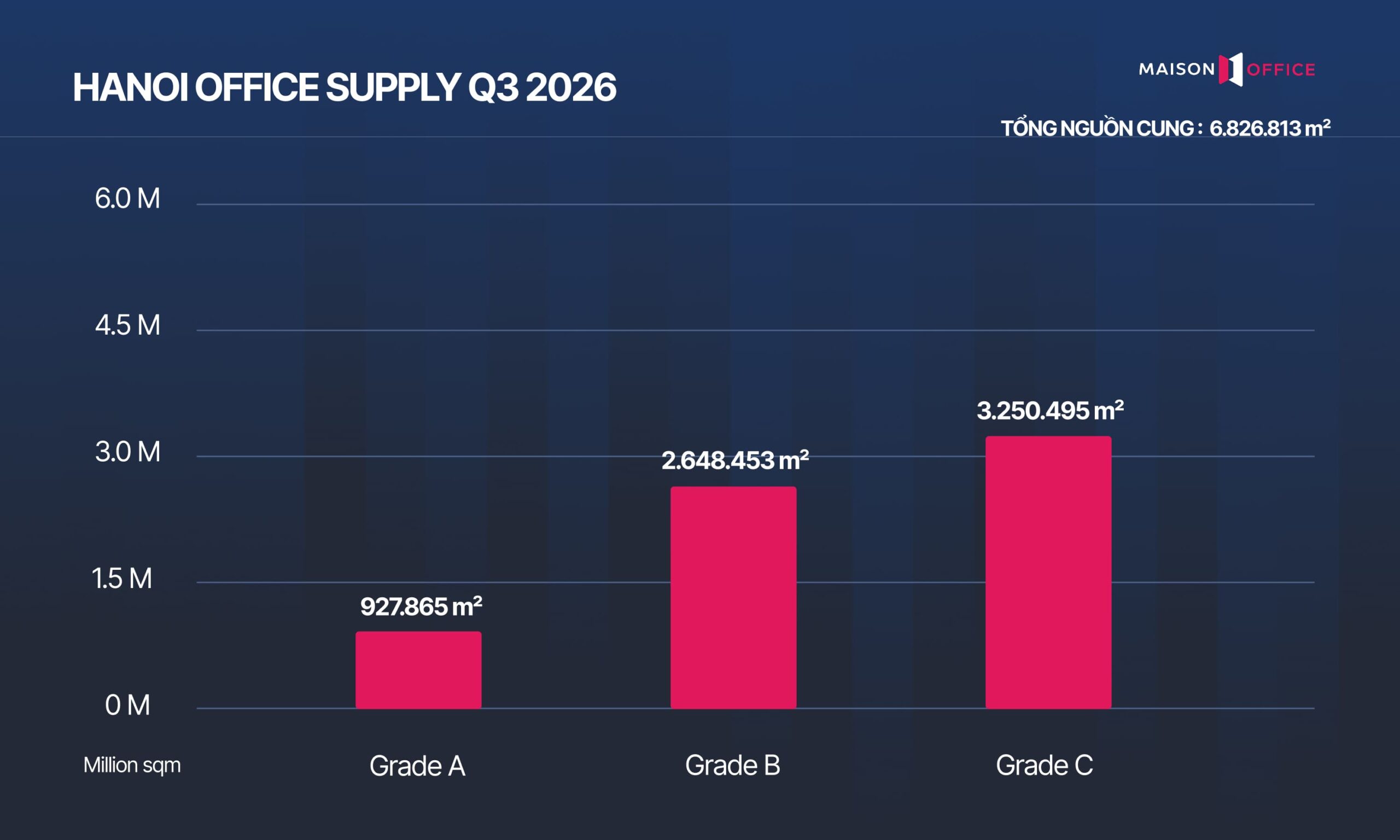
Total supply

HANOI MARKET OVERVIEW

The current office market size in Hanoi as of Q1/2026 includes all segments and geographical areas.


6.753.657

+4% YoY
Total supply
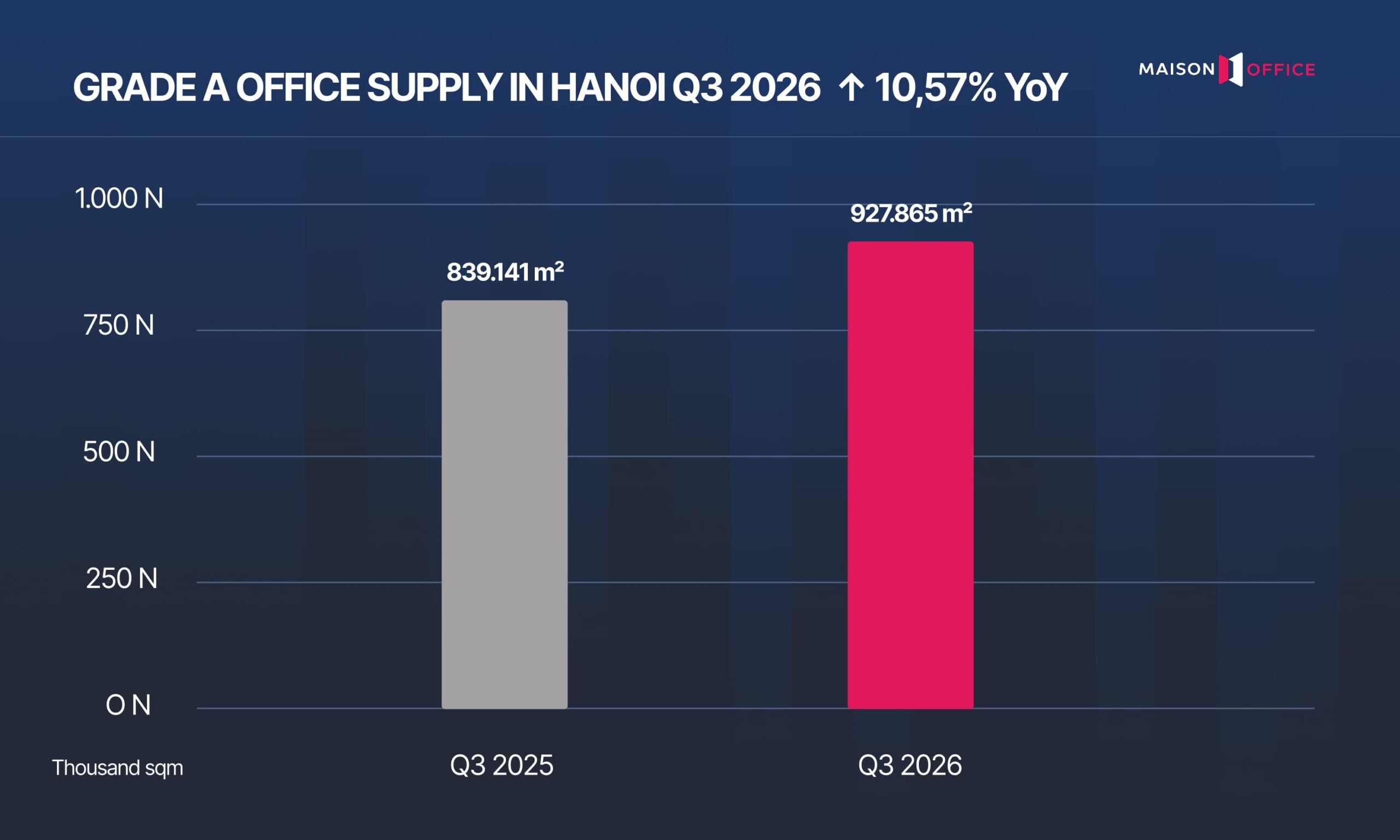
GRADE A OFFICE

920.045

+13.53% YoY
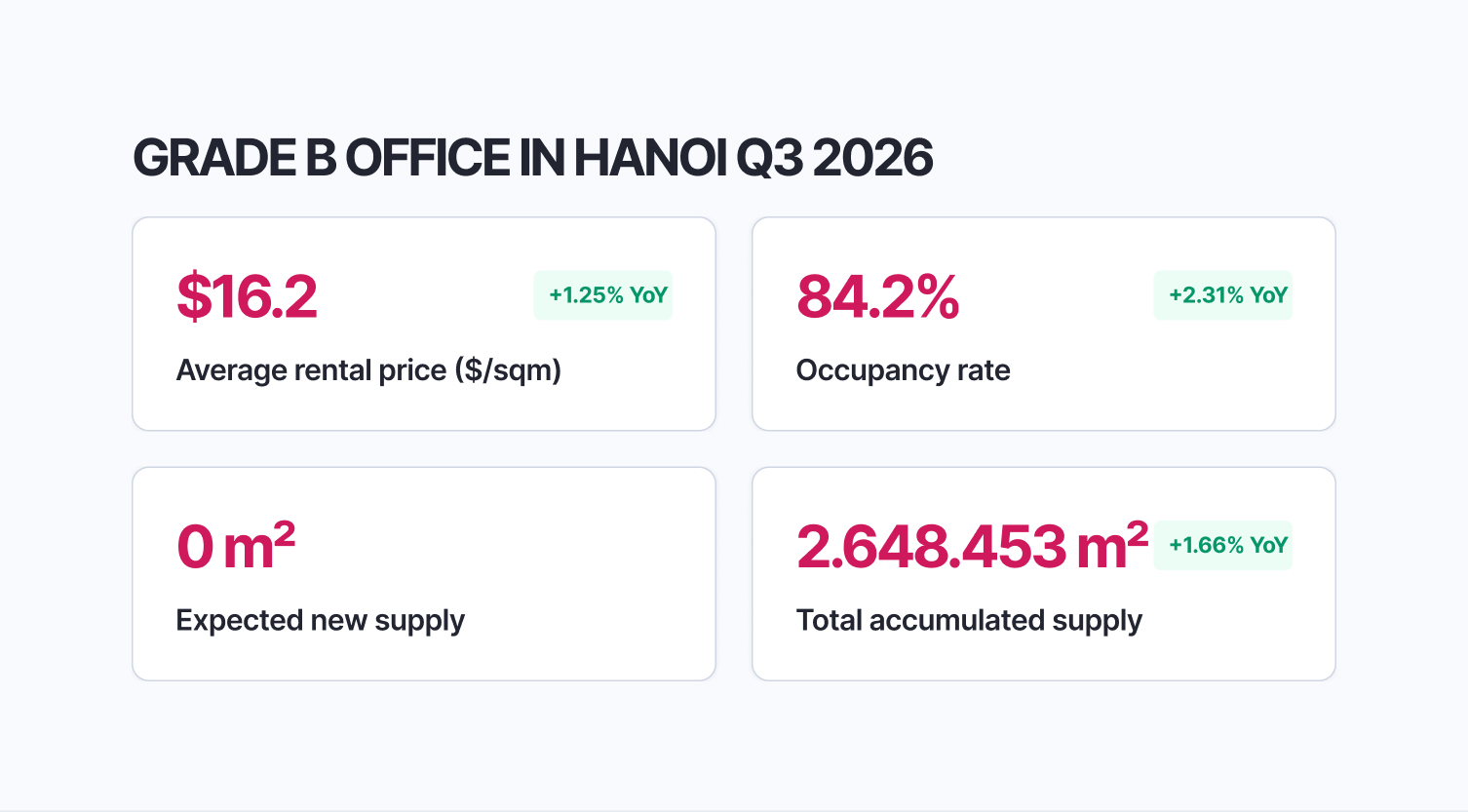
Total supply
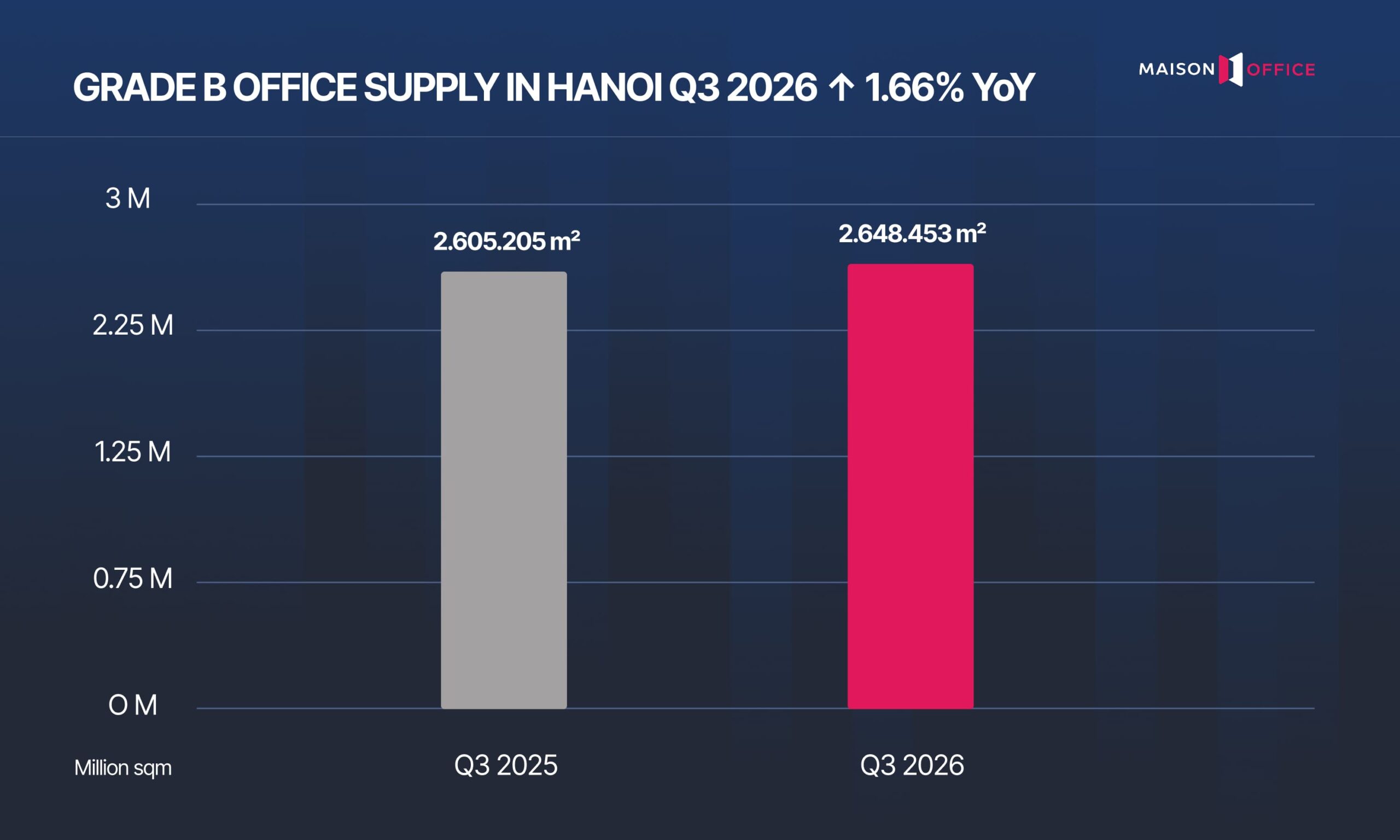
GRADE B OFFICE

2.653.287

+4% YoY

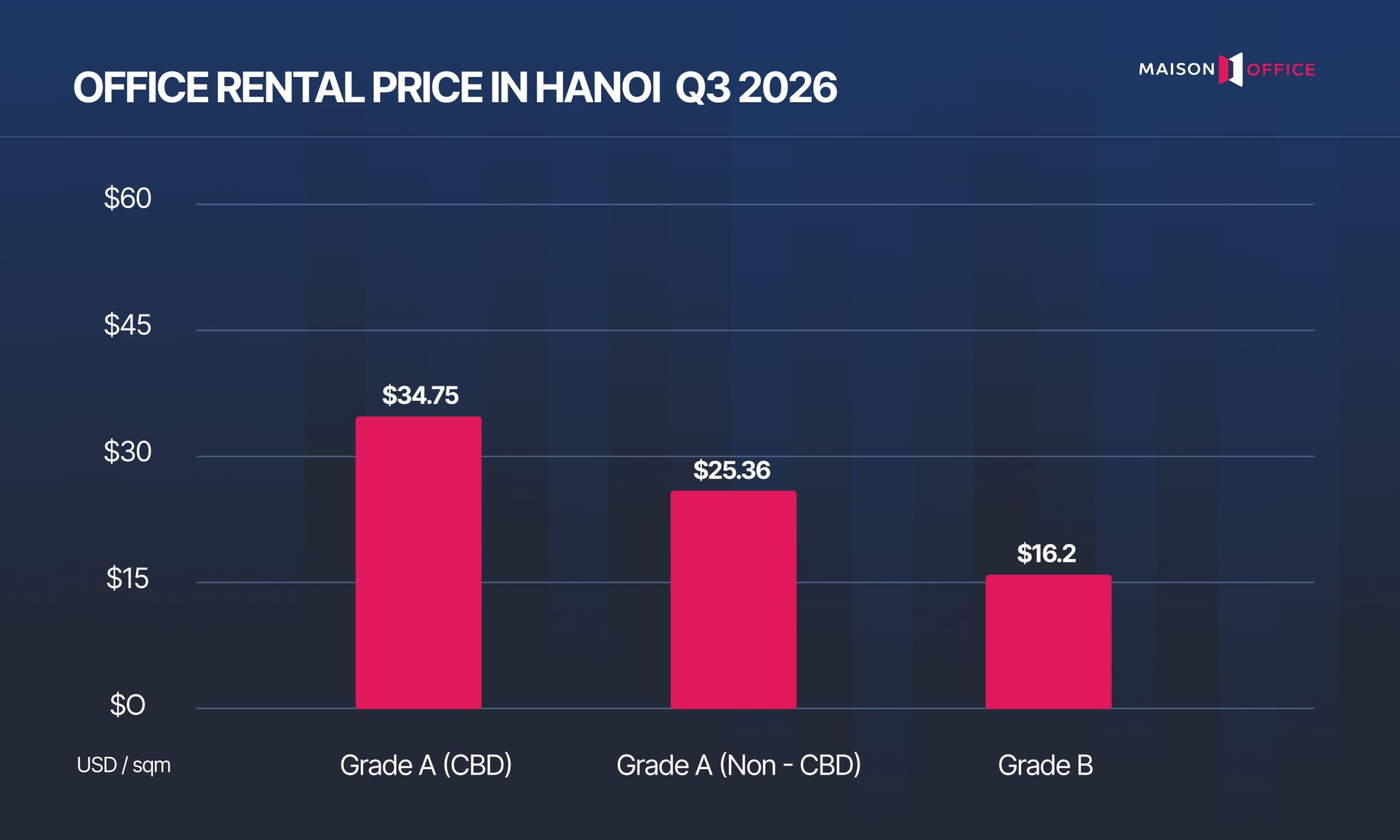
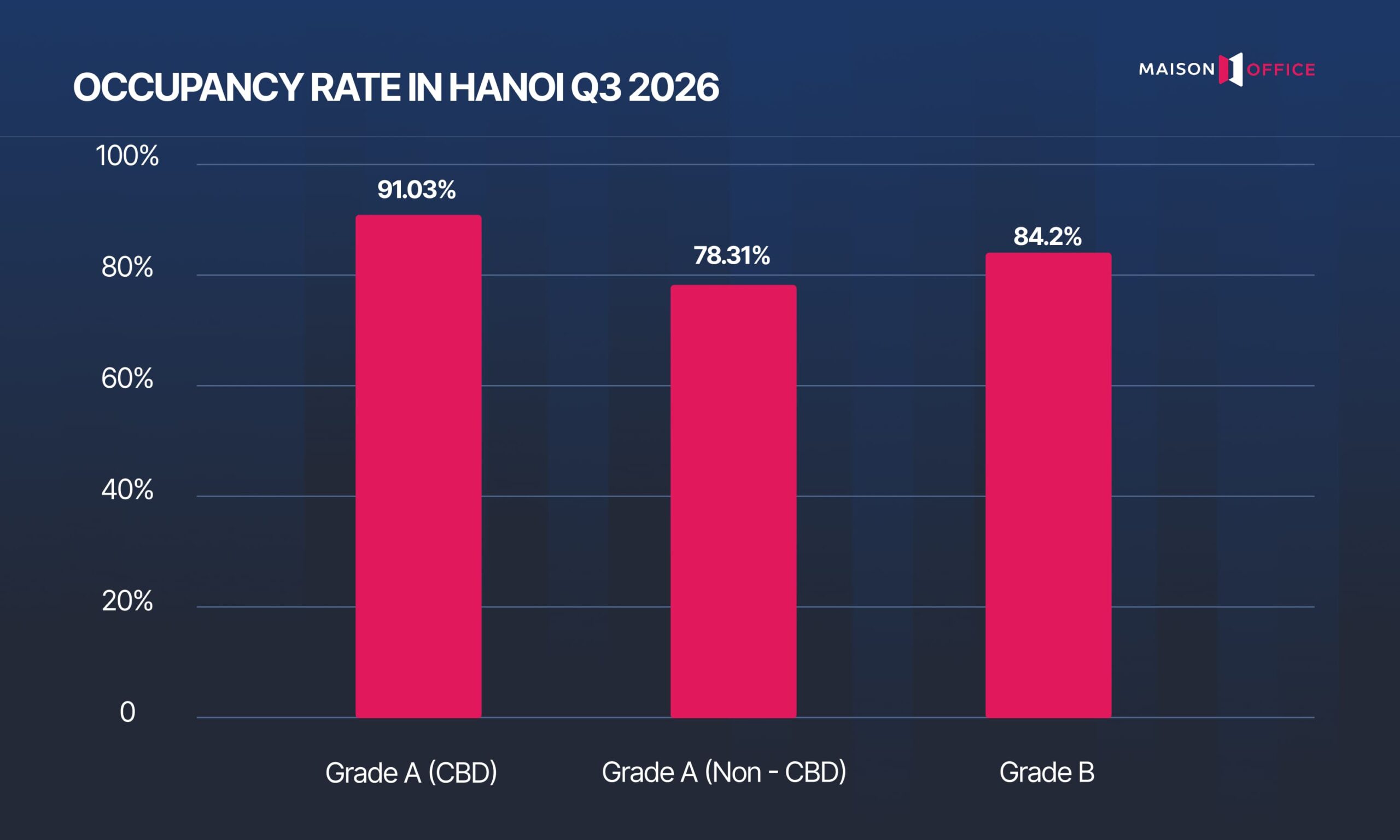
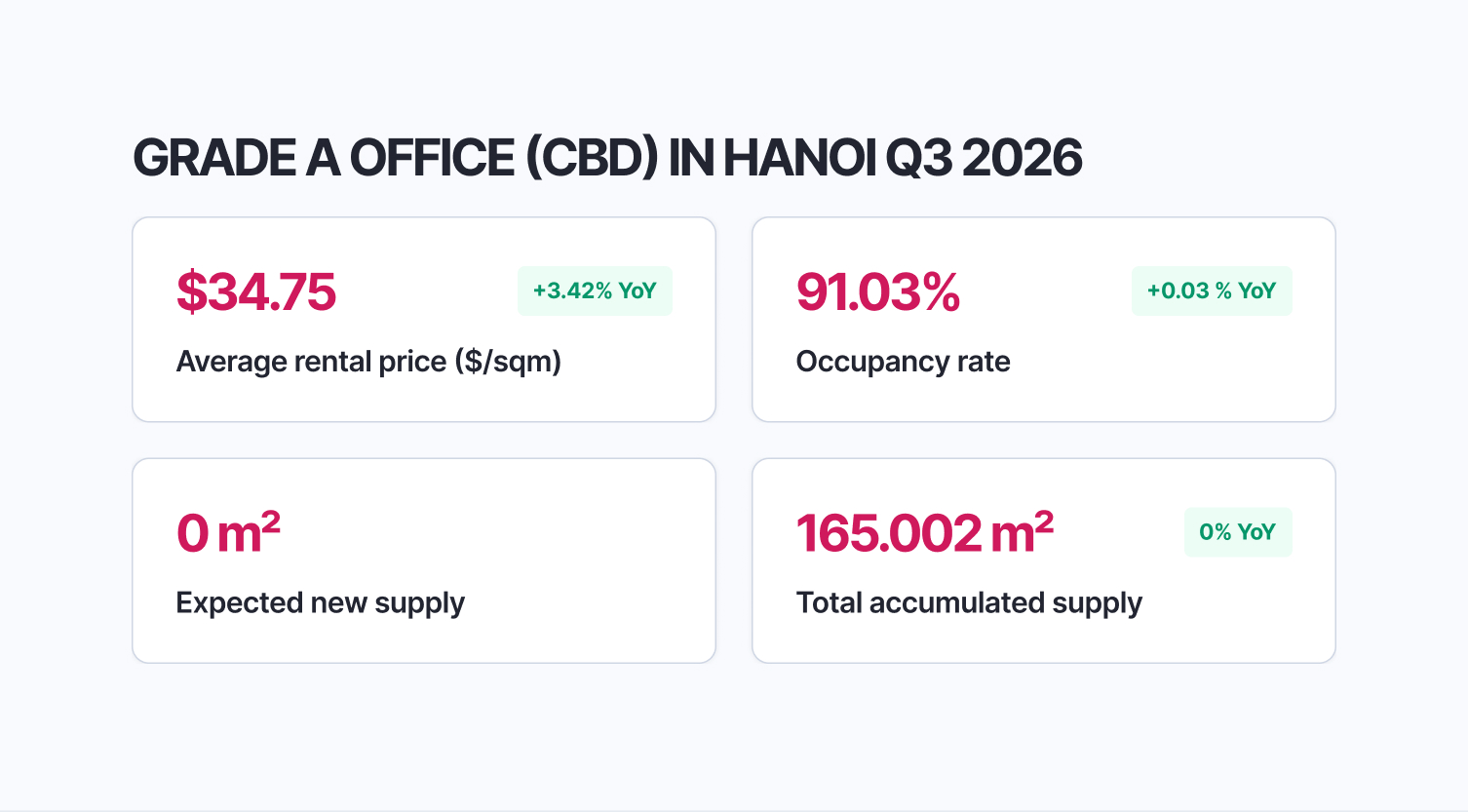
GRADE A (CBD)

Average rental price

$34.8

+0.6% YoY
Occupancy rate

89%

+1% YoY
New supply

0

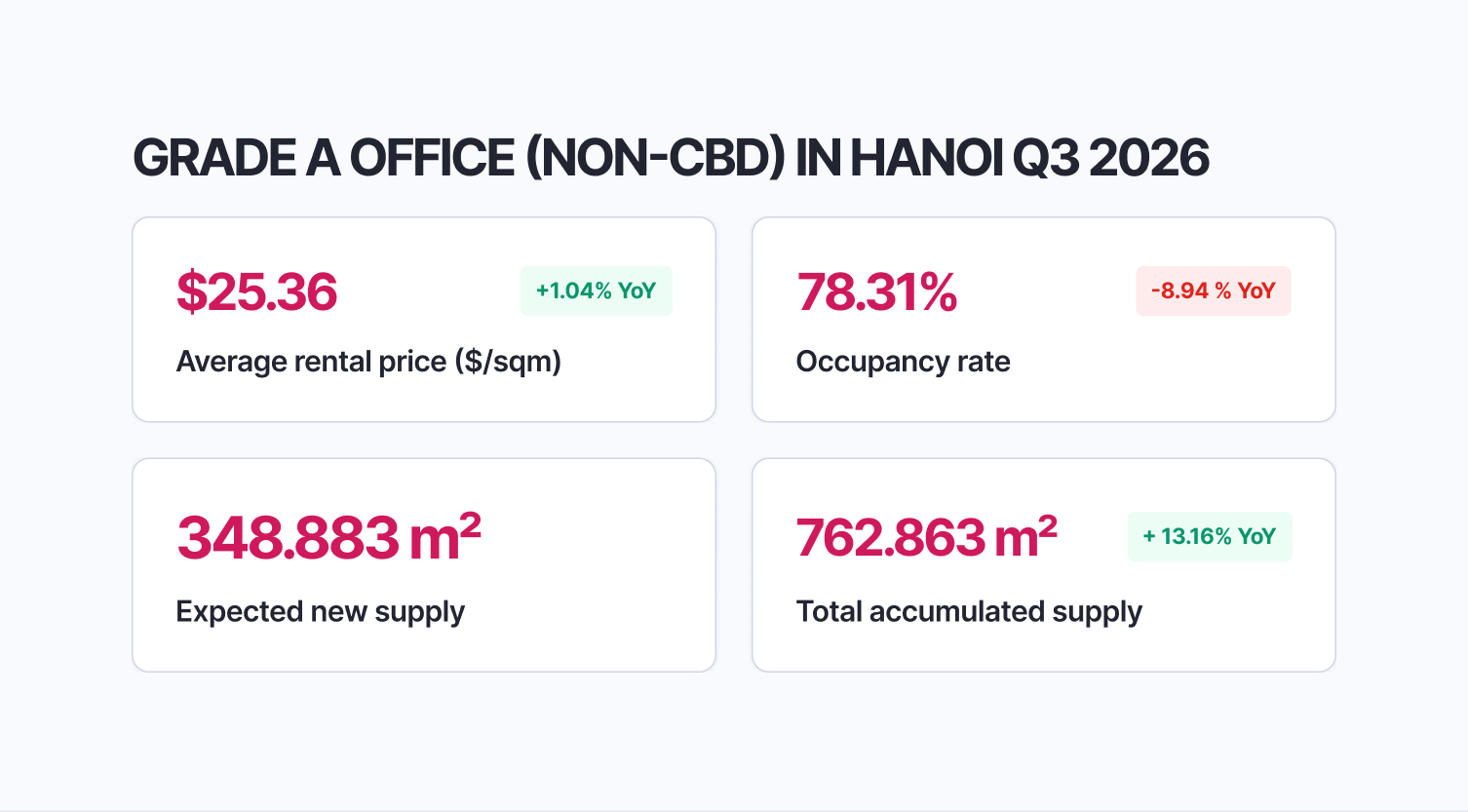
GRADE A (NON-CBD)

Average rental price

$29.3

+3% YoY
Occupancy rate

80.33%

+6.4% YoY
New supply

348.883

GRADE B

Average rental price

$16

-0.5% YoY
Occupancy rate

83%

+2% YoY
New supply

0

New supply 2026
LEADING AREA
Xuan Dinh Ward
Hanoi Office Market Overview

Ha Noi Map

Hanoi Office Market Overview Hanoi Office Market Overview
Pre-Merger
plus

Before the administrative merger, the Hanoi office market was clearly concentrated in the Hoan Kiem – Ba Dinh core, which accounted for the majority of traditional Grade A supply and served as the city’s administrative and financial center. Meanwhile, the western areas such as Cau Giay and Nam Tu Liem developed as supply expansion zones, but still operated as supporting satellites to the central district. Overall, the market remained dual-centered, with the CBD playing a clearly dominant and leading role.

Key market areas
Hoan Kiem, Ba Dinh, Cau Giay
Rental price range
$16 – $35 / sqm
Key tenant composition
Finance, legal, international organizations, ICT
Supply development axis
Expanding from the central core toward western Hanoi
Post-Merger
plus

After the administrative merger, the Hanoi office market is gradually shifting from a dual-core structure to a more clearly defined multi-polar model. The traditional central area continues to play the role of the core hub, while new wards such as Xuan Dinh and Yen Hoa are emerging as key drivers of Grade A office supply growth. This transition reflects a broader expansion of office space beyond the historical CBD, forming an “expanded CBD” structure with development momentum increasingly concentrated in the western corridor and well-planned urban areas.

Key market areas
Hoan Kiem Ward, Ba Dinh Ward, Xuan Dinh Ward
Rental price range
$16 – $35 / sqm
Key tenant composition
ICT, FDI, technology companies
Supply development axis
Multi-polarization, expanding from the central core toward Tay Ho Tay and western Hanoi

AREA COMPARISON

Criteria
Rental price
Grade A: $30–$40/sqm, Grade B: $20–$30/sqm Grade A: $25–$40/sqm, Grade B: $15–$25/sqm Grade A: $20–$30/sqm, Grade B: $15–$20/sqm Grade B+: $15–$18/sqm, Grade B: $10–$15/sqm Grade B+: $15–$20/sqm, Grade B: $13–$15/sqm
Image
Financial core of Hanoi, premium corporate positioning Administrative and diplomatic hub, professional image Dynamic development area, emerging tech hub International urban area with integrated master planning, premium positioning Expanding development zone, service-oriented business support area
Connectivity
Convenient access to government agencies and banks Good connection to CBD and western districts Convenient via ring roads, expressways, and airport access Convenient via Vo Chi Cong – Nhat Tan route Connected via Nguyen Trai and Le Van Luong corridors
Building quality
Many long-established Grade A buildings, international standards Focus on new Grade A developments with modern design Large supply of new buildings with modern standards Focus on Grade A buildings with green development standards Mainly Grade B and C buildings
Supply
Limited, near saturation Stable supply with gradual new development Largest supply scale in Hanoi market Rapidly growing supply in development phase Abundant supply, suitable for mid-range segment
Expansion potential
Difficult to expand large-scale space Moderate expansion capability Flexible, suitable for growing businesses Strong expansion potential due to large land bank Good expansion capability
Transportation
High congestion, limited parking Relatively smoother traffic conditions Well-developed infrastructure, wide roads Improving infrastructure, high future growth potential Heavy congestion during peak hours
Suitable for
Finance, banking, law, multinational corporations Large enterprises and corporate headquarters Tech companies, IT firms, startups, FDI International corporations and regional headquarters SMEs and startups

Where should businesses start?

1

Define leasing demand

Record client requirements, determine headcount, budget, and office relocation timeline. Identify preliminary supply options suitable for the market.

You have a clear understanding of the office size, budget, and workspace type that fits your business reality.

2

Select suitable locations

Analyze areas based on budget, workforce location, clients, and brand positioning. Compare pros and cons of each district within the search scope.

You identify the most optimal location based on cost, operational efficiency, and corporate image.

3

Compare & shortlist options

Filter and compare buildings based on actual rental rates, usable area, layout, and leasing conditions. Evaluate total occupancy cost to select the most suitable option.

You build a clear shortlist, saving time and avoiding unsuitable options.

4

Negotiate & finalize contract

You build a clear shortlist, saving time and avoiding unsuitable options.

You optimize rental costs and contract terms, ensuring long-term business benefits.

Key considerations when leasing office space

Actual leasing cost

Evaluate the total occupancy cost instead of just the listed rent price. Consider all operational expenses incurred during tenancy.

Usable area

Not only defined by rented size, but also by how efficiently the space supports actual working needs and business operations.

Building location

Selection based on multiple factors such as connectivity, transportation convenience, employee accessibility, and alignment with corporate positioning.

Operational standards

Reflected through building design, technical systems, and property management quality, directly impacting user experience.

Contract terms

Carefully review lease conditions including negotiation, deposit, rent-free period, handover standards, lease duration, and termination clauses.

Brand & corporate image

Choosing the right building contributes to strengthening business image and creating a positive impression for clients and employees.

Expansion potential

Assess future scalability to ensure long-term flexibility for business growth and workspace adjustments.


Timing & supply availability

Market timing and available supply conditions directly influence pricing power and negotiation effectiveness.

Market trends

Businesses prioritize high-quality buildings

The market is witnessing a clear shift toward buildings with strong operational quality, high technical standards, and stable user experience.

Companies are no longer focusing solely on rental price, but increasingly prioritizing technical systems, building operations, workplace environment, and professional image when engaging clients and partners.

ưu tiên tòa nhà chất lượng cao

Green standards and professional operations

ESG factors, green certifications, internal amenities, and property management quality are becoming key competitive advantages.

In a more competitive market environment, buildings with strong operations and clear positioning are more likely to retain tenants in the long term.

tiêu chuẩn ESG và vận hành chuyên nghiệp

Rising demand outside the traditional CBD core

Alongside the traditional central business districts, new supply and demand are gradually shifting to surrounding areas with higher land availability and long-term development potential.

This reflects a transition of the Hanoi office market toward a multi-centric model, rather than complete reliance on the traditional CBD core.

mở rộng ra ngoài lõi CBD

Consulting Perspectives

Do Chi Thong
Do Chi ThongLeasing Manager
Read More
A suitable office layout must balance location, area efficiency, rental cost, and future expansion potential. Buildings with flexible layouts, clear management structure, and transparent leasing policies often play a stronger role in decision-making.
Nguyen Minh Tu
Nguyen Minh TuLeasing Manager
Read More
Many tenants are shifting from focusing purely on rental price to evaluating total occupancy cost. Factors such as management fees, service charges, parking costs, and fit-out expenses have a direct impact on operational budgets and are increasingly considered in leasing decisions.
Tran Hue
Tran HueLeasing Consultant
Read More
Lighting quality, air quality, internal amenities, and transportation connectivity all directly impact daily operational convenience. Buildings that perform well in these aspects help businesses improve corporate image, retain employees, and enhance workspace efficiency.

Tools

Office Leasing Guide

What is Class A Office Space? Building Classification Types

Hanoi Office Market Overview Explore suitable locations, rental price levels, supply conditions, and key factors to consider before making an office leasing decision. Hanoi Office Market Data *Updated: Q1/2026 - Data compiled internally by Maison Office Total supply HANOI MARKET…

How Much Does it Cost to Rent Office Space In VietNam?

Hanoi Office Market Overview Explore suitable locations, rental price levels, supply conditions, and key factors to consider before making an office leasing decision. Hanoi Office Market Data *Updated: Q1/2026 - Data compiled internally by Maison Office Total supply HANOI MARKET…

How to find office in Vietnam: Everything you need to know

Hanoi Office Market Overview Explore suitable locations, rental price levels, supply conditions, and key factors to consider before making an office leasing decision. Hanoi Office Market Data *Updated: Q1/2026 - Data compiled internally by Maison Office Total supply HANOI MARKET…