

 Việt Nam
 English

Office Leasing Process: Fast, Simple & Efficient

 12 min read
1.1K
12 min read
1.1K
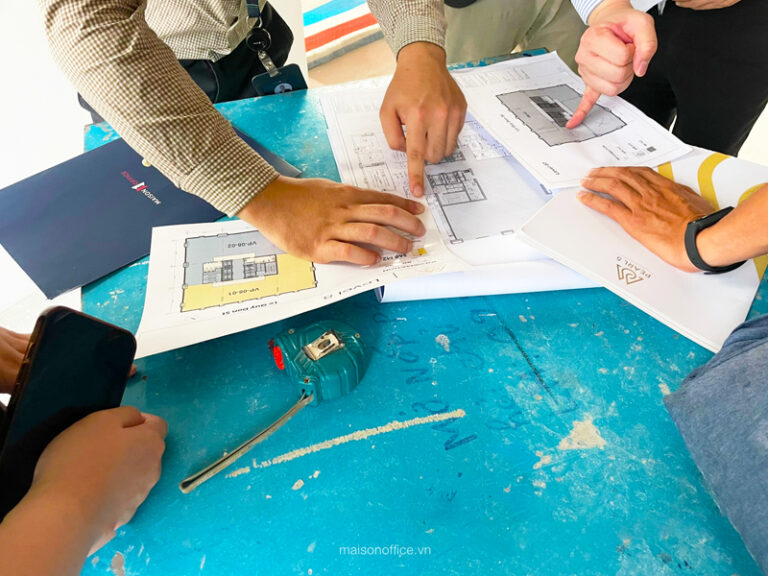
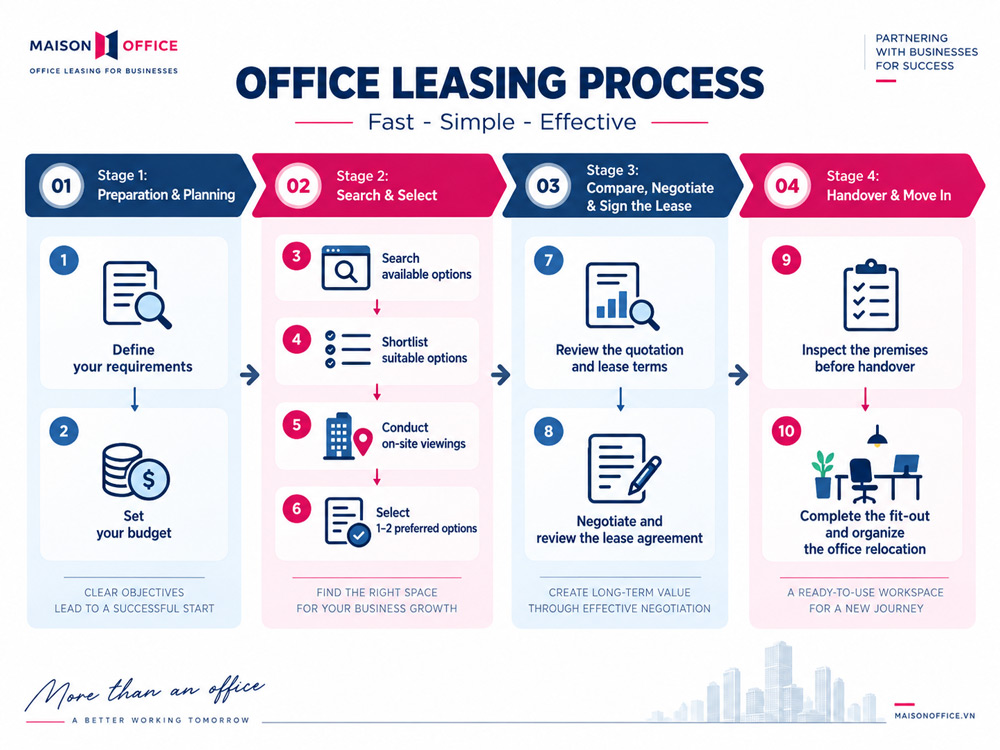
The office leasing process typically consists of 4 stages and 10 steps, beginning with defining requirements and setting a budget, followed by searching for and viewing office spaces, negotiating lease terms, signing the lease agreement, and taking handover of the premises. When businesses clearly define their space requirements, preferred location, budget, and target move-in date from the outset, it becomes easier to shortlist and compare suitable options while maintaining better control over total occupancy costs. Depending on company size, lease complexity, and fit-out requirements, the entire process typically takes around 6–10 weeks.
Table of Contents
- 1. What are the steps in the office leasing process?
- 2. Stage 1: Define Office Requirements and Leasing Budget
- 3. Stage 2: Search, View, and Select Office Space
- 4. Stage 3: Compare Costs, Negotiate, and Sign the Lease
- 5. Stage 4: Handover and Office Relocation
- 6. How Can Businesses Shorten the Office Search and Leasing Process?
- 7. How Does Maison Office Support Businesses in Finding Office Space?
- 8. Frequently Asked Questions About the Office Leasing Process
1. What are the steps in the office leasing process?
A structured office leasing process generally consists of four main stages: planning, search and selection, negotiation and lease signing, and finally handover and move-in. Each stage addresses a different set of requirements and provides the basis for the next step.
Businesses should finalize their office requirements and budget before starting the property search. Without clearly defined criteria, the list of potential buildings can become too broad, making comparisons difficult and often resulting in requirements being revised after each property viewing.
| Stage | Steps | Expected outcome |
| 1. Planning | Step 1: Define office requirements
Step 2: Set the budget and timeline |
Office leasing brief |
| 2. Search and selection | Step 3: Search the market
Step 4: Create a shortlist Step 5: Conduct property viewings Step 6: Select preferred options |
Shortlist of 1–2 preferred options |
| 3. Negotiation and lease signing | Step 7: Compare quotations
Step 8: Negotiate and review the lease agreement |
Agreed lease terms and lease agreement |
| 4. Handover and move-in | Step 9: Take handover of the premises
Step 10: Complete the fit-out and relocate |
Office ready for operation |
By following this sequence, businesses can progressively eliminate unsuitable options at each stage. This allows the final decision to be based on a consistent set of criteria rather than changing requirements after each property viewing.
2. Stage 1: Define Office Requirements and Leasing Budget
Step 1: Define Office Leasing Requirements
Before searching for a building, businesses should align internally on their office requirements for the intended lease term. The most important factors include headcount, estimated space requirements, preferred location, target handover date, and available budget.
For businesses planning to increase headcount, space requirements should account for future expansion rather than being calculated solely based on the current number of employees. Similarly, office location should be evaluated according to actual operational needs, such as accessibility for clients and business partners, access to the workforce, and proximity to transport links frequently used by the company.
The office leasing brief should clearly define the following requirements:
- Headcount: Current number of employees and projected changes during the lease term
- Office area: Determined based on headcount, workplace layout, and required functional areas
- Location: Preferred areas and accessibility for clients, business partners, and employees
- Building grade: Grade A, B, C, or flexible office solutions
- Occupancy timeline: Target handover date and planned date for the office to become fully operational
- Lease term: Based on business plans and future expansion requirements
- Technical requirements: Air conditioning, backup power, floor loading capacity, ceiling height, elevators, parking, and other specific technical requirements
The more specific the leasing brief, the easier it is to manage the property search. Clearly defined requirements also help businesses avoid spending time viewing buildings that do not meet their essential criteria from the outset.
>> Businesses can use the office space calculator and refer to the office building evaluation criteria to develop a more detailed leasing brief aligned with their actual requirements.

Step 2: Set the Leasing Budget Based on Total Occupancy Cost
The rental rate per sqm does not represent the full amount a business will pay over the lease term. When setting a budget, businesses should account for associated charges and other costs incurred during occupancy.
The following calculation can be used as a reference:
Total recurring occupancy cost = Rent + service charge + VAT + parking fees + electricity and air-conditioning costs + after-hours charges + other operating expenses
In addition to recurring costs, businesses should budget for upfront expenses such as the security deposit, office interior design and fit-out, IT infrastructure, office relocation, signage, and reinstatement costs where required under the lease agreement.
Separating upfront costs from recurring occupancy costs allows the finance team to prepare a more accurate budget. It also provides a clearer basis for comparing two office buildings with similar rental rates but different fee structures.

3. Stage 2: Search, View, and Select Office Space
Step 3: Search for Suitable Office Availability
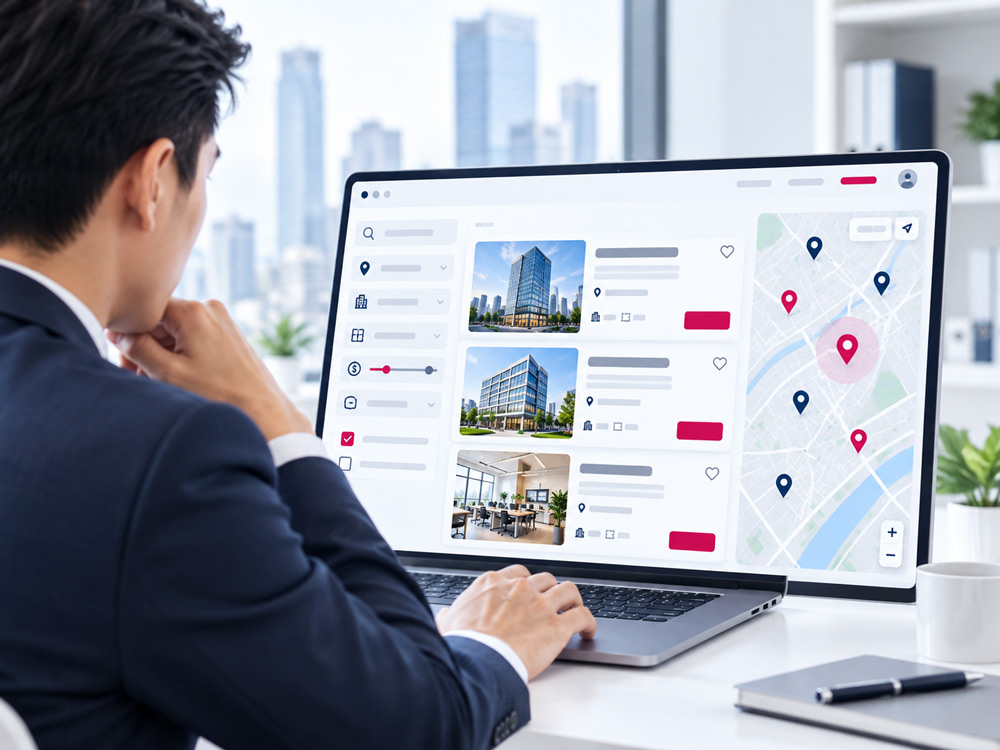
Once the business has clearly defined its requirements and budget range, it can begin searching for suitable office buildings. At this stage, options should be screened against the criteria established from the outset to avoid spending time on properties that do not meet the requirements.
A practical screening sequence can start with:
Location → office area → budget → availability and handover date → building standards → lease terms
This approach helps reduce the number of options requiring detailed assessment and prevents businesses from being influenced too early by property images or advertised rental rates.
>> Businesses in Ho Chi Minh City can explore available offices for lease in Ho Chi Minh City. For office requirements in Northern Vietnam, refer to the list of offices for lease in Hanoi.
Step 4: Create a Shortlist and Compare Office Buildings
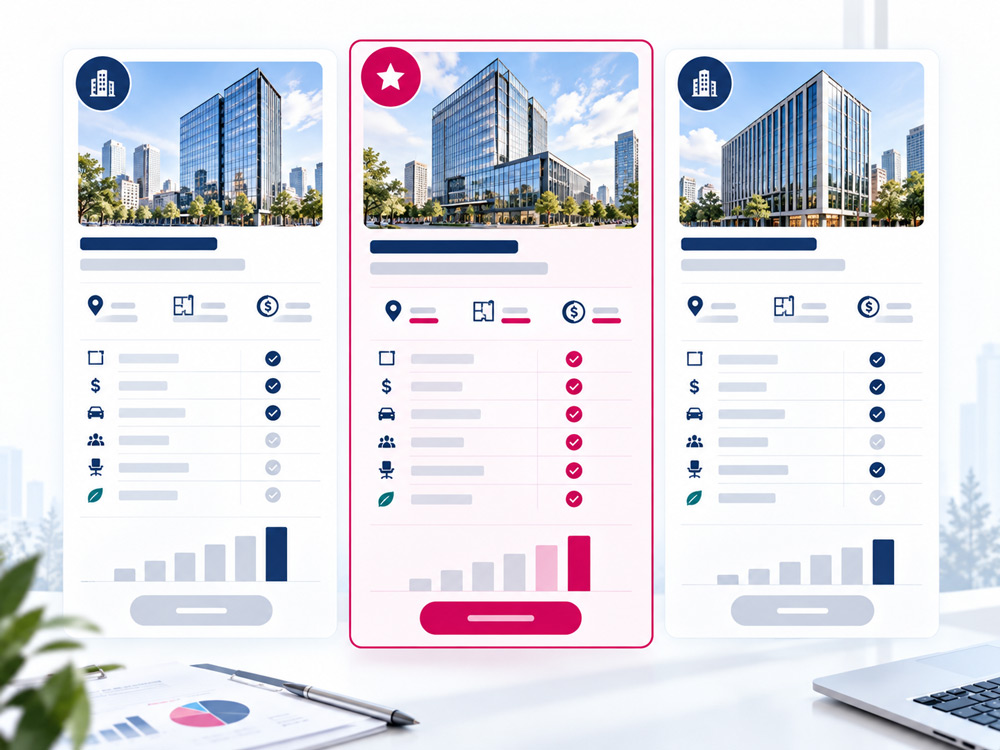
After reviewing available office supply, businesses should narrow the options down to the buildings that best meet their requirements for space, location, budget, and lease terms. A focused shortlist makes property viewings and comparisons more efficient while reducing time spent on unsuitable options.
For an objective assessment, shortlisted buildings should be compared using the same set of criteria:
| Criteria | What to compare |
| Office area | Leasable area and actual usable space |
| Rental rate | Quoted rent and associated charges |
| Total occupancy cost | Estimated monthly occupancy budget |
| Handover condition | Condition of the premises upon handover |
| Parking | Availability and parking fees |
| Lease term | Minimum lease term and renewal conditions |
| Fit-out | Rent-free or supported fit-out period |
| Building systems | Air conditioning, backup power, and elevators |
| Lease terms | Key commercial terms and conditions |
Businesses should not evaluate one building based solely on its rental rate while assessing another based on total occupancy cost. All options should be compared using the same calculation method, at the same point in time, and under comparable lease conditions for the results to be meaningful.
Step 5: Conduct On-Site Office Viewings
Information provided on websites, marketing materials, or quotations reflects only part of an office’s overall quality. An on-site viewing allows businesses to assess the actual floor layout, technical systems, and operating conditions directly.
During the viewing, businesses should inspect both the leased premises and common areas. An office floor plan that appears suitable on paper may be difficult to configure if it contains numerous columns, a large building core, or an inefficient floor shape.
Key items to check during an office viewing include:
- Floor shape and layout efficiency
- Location of columns, lift cores, and difficult-to-use areas
- Natural light
- Office air-conditioning system
- Backup power supply
- Elevators
- Car and motorbike parking
- Reception lobby
- Access and conditions for transporting fit-out materials
- Surrounding amenities
- Actual handover condition
Businesses should use the same checklist for every property viewing. When each building is assessed against consistent criteria, the project team can consolidate its findings more effectively and reduce the influence of subjective impressions during individual viewings.

Step 6: Select 1–2 Preferred Options
After completing the property viewings, businesses should narrow the shortlist down to 1–2 preferred options before proceeding to the negotiation stage.
An office should not be selected based solely on a lower rental rate. A suitable option should be evaluated based on total occupancy cost, layout efficiency, location, handover conditions, and the lease terms applicable throughout the contract period.
For example, a building with a lower rental rate may have numerous columns that reduce usable space and layout efficiency. Conversely, an option with a slightly higher rental rate may provide a more efficient floor plate, a longer fit-out support period, and fewer additional costs, making it more suitable within the overall occupancy budget.

4. Stage 3: Compare Costs, Negotiate, and Sign the Lease
Step 7: Review the Quotation and Lease Terms
Once the business has identified its preferred options, the landlord will provide a more detailed quotation and commercial terms. At this stage, the focus should shift from comparing buildings to comparing the total financial obligations over the lease term.
An office leasing quotation typically includes more than the base rental rate. Businesses should carefully review the following:
- Rental rate
- Service charge
- VAT
- Lease term
- Security deposit
- Payment schedule
- Rent-free or fit-out period, if applicable
- Rental escalation terms
- Parking fees
- After-hours air-conditioning charges
- Handover condition
- Reinstatement obligations
If the shortlisted options have different cost structures, businesses should calculate their costs over the same lease term to make an accurate comparison. This helps identify cases where an option with a lower rental rate may result in higher additional expenses during occupancy.
In some transactions, the parties may use a Letter of Intent (LOI) to record the commercial terms discussed before finalizing the lease agreement. Businesses should review the specific provisions of each document carefully and should not assume that all LOIs have the same scope or level of legal obligation.

Step 8: Negotiate and Review the Lease Agreement
During negotiations, businesses should consider the total value of the lease transaction rather than focusing solely on reducing the rental rate. Other commercial terms can directly affect occupancy costs and operational flexibility throughout the lease term.
Key points for negotiation typically include the rental rate, fit-out period, rent commencement date, rental escalation, renewal rights, termination conditions, and reinstatement obligations.
Once the commercial terms have been agreed upon, the lease agreement should be reviewed carefully to ensure that it accurately reflects what both parties have negotiated. Businesses should check:
- Landlord information and legal capacity
- Landlord’s right to lease the premises
- Leasable area and the method used to calculate it
- Rental rate and associated charges
- Handover date
- Rent commencement date
- Lease term
- Fit-out conditions
- Renewal rights
- Termination conditions
- Reinstatement obligations
- Appendices and accompanying technical documents
For high-value transactions or leases involving complex legal provisions, businesses should have their legal department or a qualified lawyer review the lease agreement before signing.

5. Stage 4: Handover and Office Relocation
Step 9: Inspect the Premises Before Handover
Once the lease agreement has been signed and the handover date arrives, the business should inspect the premises before signing the handover record.
The handover record documents the condition of the office at the time the premises are transferred to the tenant. This is particularly important because it may affect the tenant’s responsibilities for repairs, maintenance, or reinstatement at the end of the lease term.
Businesses should check:
- Area and boundaries of the leased premises
- Floors, ceilings, walls, and doors
- Air-conditioning system
- Electrical and lighting systems
- Fire protection equipment
- Electricity meter, if applicable
- Fixtures and equipment belonging to the landlord
- Any defects or incomplete items
If the actual condition differs from what was agreed, the discrepancies should be recorded directly in the handover document, together with an agreed deadline for the landlord to address them.

Step 10: Complete the Office Fit-Out and Organize the Relocation
After taking handover of the premises, the business can begin implementing the office design, fit-out, and relocation plan.
The fit-out schedule should be coordinated with the building’s permitted fit-out period, the requirements of the building management team, and the rent commencement date. If these milestones are not properly aligned, the business may incur additional costs or need to adjust its relocation schedule.
Depending on the handover condition, the scope of work may include workspace planning, electrical systems, data networks, meeting rooms, reception and visitor areas, signage, and access control systems.
Office interior design and fit-out should be managed as a separate project with a defined schedule, budget, and designated person in charge. Businesses requiring professional support for office design and fit-out can refer to Maison Interior.

6. How Can Businesses Shorten the Office Search and Leasing Process?
The office leasing process often takes longer when businesses repeatedly change their requirements or have not clearly identified who has decision-making authority. The most effective way to shorten the process is therefore to define the key requirements before starting the office search.
Before reviewing available office options, businesses should complete five key steps:
- Agree on the office leasing requirements.
- Define an affordable budget range.
- Designate the person or team with decision-making authority.
- Set the target date for taking handover and occupying the office.
- Clearly distinguish between non-negotiable requirements and negotiable preferences.
For example, if proximity to clients is a mandatory requirement while the building grade is flexible, the search team can review available office supply within a clearly defined scope. Conversely, if every criterion is treated as mandatory, the number of suitable options may be significantly reduced.
Businesses should also agree on the evaluation method before conducting property viewings. Using a consistent set of criteria allows team members to discuss and compare options based on the same information rather than applying different standards.

7. How Does Maison Office Support Businesses in Finding Office Space?
With more than 10 years of experience in office leasing consultancy in Ho Chi Minh City and Hanoi, Maison Office serves as a trusted office leasing partner for hundreds of domestic and international businesses.
Maison Office supports businesses throughout the office leasing process, from defining requirements and arranging property viewings to lease negotiations and post-lease operational support.
 |
 |
Why Choose Maison Office?
- Continuously updated market data covering more than 95% of office buildings in Ho Chi Minh City and Hanoi, from Grade A, B, and C buildings to serviced offices. Consultation is free of charge, client information is kept confidential, and no service fee is charged to tenant businesses.
- Reduce office search time by up to 50% compared with searching independently, supported by a filtering system tailored to each business’s requirements.
- An experienced advisory team with an understanding of sector-specific requirements, providing suitable workplace solutions for businesses in technology, finance, insurance, logistics, manufacturing, and other industries.
- Support with lease negotiations and lease agreement reviews to help businesses reduce legal risks and identify potential hidden costs.
Some of the businesses Maison Office has successfully assisted include:
| Business | Leased Area | Office Building | Industry |
| Global Poongin Vina | 4,412 sqm | Victory Tower | Garment Manufacturing (South Korea) |
| Digiworld Vietnam | 1,361 sqm | ETOWN Central | Technology (Vietnam) |
| RSM Vietnam | 910 sqm | L’MAK The Signature | Audit (United States) |
| BYD Auto Vietnam | 859 sqm | Cobi Tower | Automotive (China) |
| Mitsui Oil Exploration | 472 sqm | Saigon Centre 2 | Oil & Gas (Japan) |
Maison Office has assisted more than 300 businesses over the past three years, with a client satisfaction rate of up to 98%.
Looking for office space? Maison Office can assist you with:
- Developing an office strategy aligned with your business’s stage of growth
- Reducing search time and optimizing long-term occupancy costs
- Strengthening your position in negotiations with landlords and developers
- Supporting legal, contractual, and post-lease operational matters
Contact Maison Office today for a free consultation and receive a tailored shortlist of office spaces that match your business requirements.
8. Frequently Asked Questions About the Office Leasing Process
8.1 How far in advance should a business start looking for office space?
Businesses should generally begin the office search 1.5 to 3 months before the planned relocation date. For larger businesses or projects requiring extensive office fit-out, the process may take 4–6 months to allow sufficient time for property viewings, negotiations, lease signing, and fit-out.
Starting earlier generally provides access to a wider range of suitable options and more time to negotiate lease terms.
8.2 Should small businesses consider a serviced office?
Yes. For small businesses, startups, or flexible teams, a serviced office can be a suitable option because it typically offers a more predictable cost structure, flexible lease terms, and ready-to-use workspace without requiring a separate investment in furniture and office operations.
This model also allows businesses to establish a professional workplace from the start while reducing the upfront investment associated with fitting out a traditional office.
8.3 Does Maison Office charge businesses a consultancy fee?
No. Maison Office provides businesses with free support throughout the office leasing process, from defining requirements and searching for suitable options to arranging property viewings, negotiating lease terms, and assisting with lease signing.
Maison Office’s service fee is paid by the landlord under standard brokerage commission arrangements in the office leasing market. Tenant businesses do not pay an additional consultancy fee to Maison Office.
Editor and content team manager at Maison Office.
With over 5 years of experience in consulting and extensive content editing in the real estate services and interior design field. Sharing valuable information with customers, partners, and attracting millions of views.


