

 Việt Nam
 English

When Is the Best Time of Year to Lease an Office?

 6 min read
508

Choosing the best time of year to lease an office is an important factor in helping a business optimize operating costs and secure a suitable workspace. In practice, office rents in Ho Chi Minh City and Hanoi fluctuate by quarter and are influenced by market demand, occupancy rates, and landlord incentives. Understanding when rents rise and when promotions are more widely available enables businesses to plan proactively and sign leases at more competitive rates.
Table of Contents
- 1. Overview of the Office Leasing Markets in Ho Chi Minh City and Hanoi
- 2. When Is the Best Time of Year to Lease an Office?
- 3. Comparison of Quarterly Office Rent Fluctuations
- 4. Effective Office Leasing Strategies for Each Period
- 5. Maison Office Helping Businesses Lease Offices More Effectively
- 6. (FAQ) – Frequently Asked Questions
1. Overview of the Office Leasing Markets in Ho Chi Minh City and Hanoi
The office leasing markets in Ho Chi Minh City and Hanoi recorded considerable fluctuations during 2024–2025. According to market reports, occupancy in Grade A buildings in both cities remained high at 90–95%, while Grade B and Grade C performance varied significantly depending on location and price.
- Ho Chi Minh City: In Q2 2024, average rents increased by approximately 4–6% quarter-on-quarter, particularly in central District 1 and the Thu Thiem New Urban Area. Grade A office rents ranged from USD 55–70/sqm/month, while Grade B rents were approximately USD 25–40/sqm/month. Demand came mainly from technology, finance, and e-commerce companies expanding their offices.
- Hanoi: New supply was concentrated in Cau Giay, Nam Tu Liem, and Ba Dinh, helping rebalance the market. Grade A rents ranged from USD 35–50/sqm/month, while Grade B rents were approximately USD 20–30/sqm/month. Foreign companies, particularly those from Japan, South Korea, and Singapore, continued to account for a large share of new tenants.
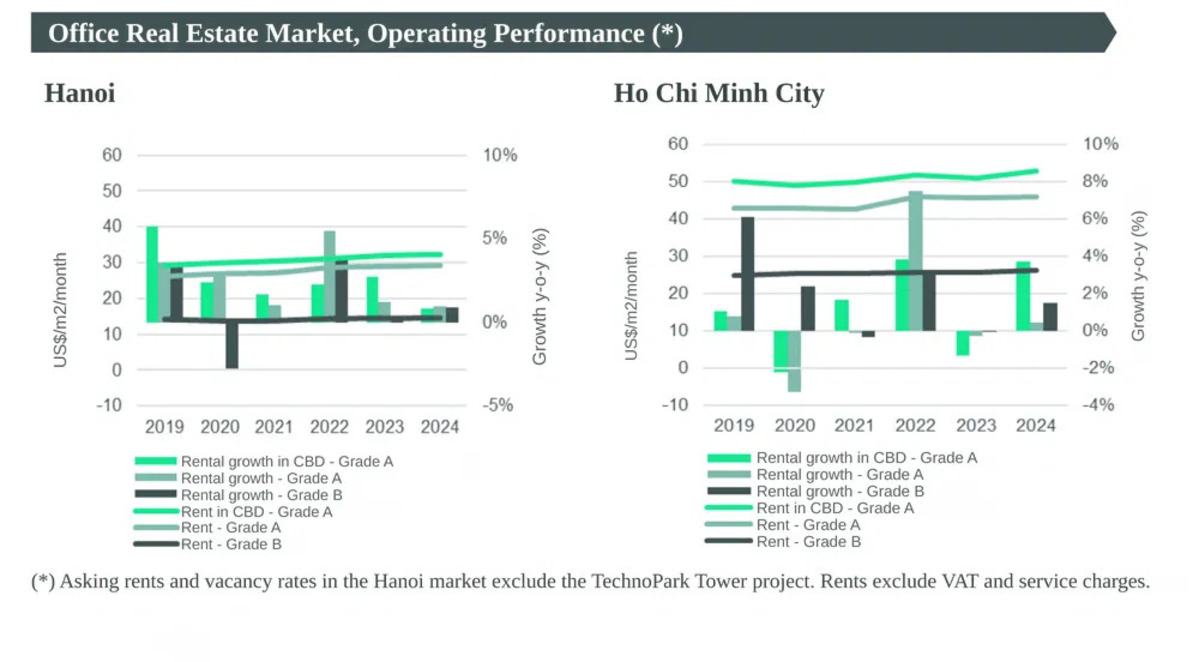
The office markets in Ho Chi Minh City and Hanoi reflect both the health of the economy and a clear quarterly cycle. This pattern provides the basis for businesses to identify the best time of year to lease an office at a favourable price.
2. When Is the Best Time of Year to Lease an Office?
The best office rental conditions generally occur in the second half of the year, during Q3 and Q4, particularly in November and December. Demand is often lower during this period, and landlords tend to offer more incentives to fill vacant space before the end of the financial year.
2.1 Q1 (January to March): Demand Rises After Tet
After the Lunar New Year holiday, many companies begin implementing expansion plans or establishing new operations, causing demand for office space to rise sharply. Vacancies in Grade A and Grade B buildings often fall quickly, particularly in central districts. Rents therefore tend to edge upward, while negotiating leverage weakens. Companies seeking Q1 occupancy should prepare their plans before Tet to retain a wider range of suitable options.

2.2 Q2 (April to June): Rental Conditions Stabilize
The office leasing market becomes more balanced as the remaining vacant areas are offered at stable prices. Businesses can find more buildings that fit their budget while still providing convenient locations. Although rents do not fall sharply, negotiations are more flexible than in Q1, particularly in the Grade B and Grade C segments.
2.3 Q3 (July to September): A Favourable Time to Negotiate
Q3 is usually a cooling period for the office leasing market, with demand lower than in the first half of the year. Many buildings introduce incentives such as overtime-fee waivers, fit-out cost support, or rent reductions to fill vacant areas. This is considered a particularly favourable time to negotiate better terms, especially for long-term leases or large spaces.
2.4 Q4 (October to December): More Incentives and Major Year-End Deals
At year-end, landlords intensify occupancy programmes, creating substantial opportunities for tenants. Businesses may find attractive deals ranging from rent reductions to bundled service packages. This is also an appropriate time to secure a long-term lease and fix costs when rents may rise in the following year. For small companies and startups, Q4 provides an opportunity to obtain a quality office while controlling costs.

3. Comparison of Quarterly Office Rent Fluctuations
Office rents in Ho Chi Minh City and Hanoi vary clearly across the year. The following table compares average quarterly movements based on market reports for 2024–2025.
| Quarter | Market characteristics | Average Grade A rent | Average Grade B rent | Key trend |
| Q1 January–March | High demand after Tet; vacancies decline quickly |
HCMC: USD 60–70/sqm/month Hanoi: USD 40–50/sqm/month |
HCMC: USD 30–40/sqm/month Hanoi: USD 22–28/sqm/month |
Rents edge upward; negotiations are more difficult |
| Q2 April–June | Stable period; the market becomes more balanced |
HCMC: USD 58–68/sqm/month Hanoi: USD 38–48/sqm/month |
HCMC: USD 28–38/sqm/month Hanoi: USD 20–27/sqm/month |
Rents remain stable; negotiations become easier |
| Q3 July–September | Demand declines; landlords offer more incentives |
HCMC: USD 55–65/sqm/month Hanoi: USD 35–45/sqm/month |
HCMC: USD 25–35/sqm/month Hanoi: USD 18–25/sqm/month |
Softer rents and more service incentives |
| Q4 October–December | Year-end period; landlords prioritize occupancy |
HCMC: USD 56–66/sqm/month Hanoi: USD 36–46/sqm/month |
HCMC: USD 26–36/sqm/month Hanoi: USD 19–26/sqm/month |
Attractive deals and an advantage for long-term leases |
Analysis
- Q1: Rents are generally the highest of the year, mainly because of post-Tet expansion demand and limited vacant space.
- Q2: The market is balanced and rents are stable, giving businesses more time to inspect and compare options.
- Q3: This is generally the period with the softest rents, giving businesses more opportunities to negotiate and receive landlord incentives.
- Q4: Although rents edge up from Q3, year-end incentives such as rent reductions, service-fee waivers, and fit-out support keep the effective total occupancy cost low, particularly for long-term leases.
Maison Office helps businesses analyse quarterly rent movements and advises on suitable solutions for selecting the right office.
4. Effective Office Leasing Strategies for Each Period
To optimize office leasing costs and secure suitable workspace, businesses need both an understanding of quarterly market movements and a flexible leasing strategy.
- During Q1: Prepare the office search and inspection plan from the end of the previous year. Entering the market early gives the business more options and limits exposure to higher rents when demand surges after Tet.
- During Q2: As the market stabilizes, use the additional time to compare options and select the building that best fits the budget. This is also a favourable period for negotiating lease terms, particularly for small and medium-sized spaces.
- During Q3: Use the cooling market and wider range of building incentives to negotiate better rent and secure a long-term lease at a lower fixed cost. This period is particularly suitable for startups and small and medium-sized enterprises seeking to reduce expenditure.
- During Q4: Prioritize major year-end deals. Businesses may obtain packages that include service-fee waivers, fit-out support, or long-term rent reductions. This is an appropriate time to renew a lease or relocate at a reasonable cost.
An effective strategy depends on more than rent. The lease signing date must also align with the business plan. The more proactively a company prepares, the stronger its negotiating position will be.
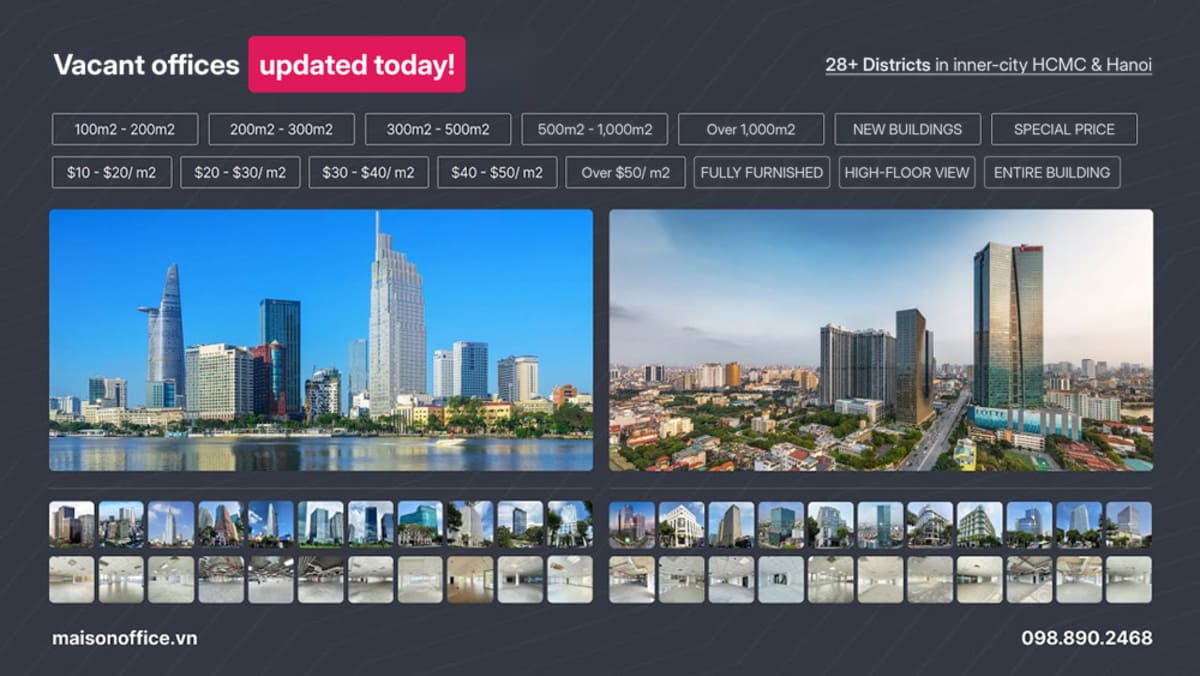
Understanding the characteristics of each period helps a business plan its lease. Applying the most effective strategy, however, requires support from an adviser with detailed market knowledge. This is the role Maison Office provides throughout the office search process.
5. Maison Office Helping Businesses Lease Offices More Effectively
Finding the best time to lease an office is only one part of a cost-optimization strategy. More importantly, the business must select the right space for its long-term development needs. With more than 10 years of experience, Maison Office advises thousands of companies throughout the process, from market surveys and building comparisons to lease negotiations and workspace handover.
 |
 |
Maison Office maintains continuously updated data on the Ho Chi Minh City and Hanoi markets, helping businesses identify an advantageous time to sign and access a wide range of Grade A, Grade B, Grade C, and serviced-office buildings. The Maison Office advisory team is committed to offering solutions that optimize costs, save time, and maintain transparency throughout the leasing process.
Contact Maison Office for a free consultation and a proposed shortlist of offices that match your company’s size and workplace requirements.
6. (FAQ) – Frequently Asked Questions
6.1 When Are Office Rents Usually Lowest?
Office rents are generally lowest in Q3 and Q4, when demand declines and landlords introduce more incentives to fill vacant space. This is an appropriate period for businesses to negotiate rent and sign long-term leases.
6.2 When Are Office Rents Usually Highest?
Office rents are generally highest in Q1, immediately after the Lunar New Year. Expansion and new-company demand reduces available supply and weakens tenants’ negotiating position.
6.3 Should a Small Business Lease an Office at Year-End?
Yes. At year-end, many landlords offer promotional policies and cost support. This gives small businesses and startups an opportunity to reduce expenditure while still finding a suitable office.


