

 Việt Nam
 English

Office Building Signage Regulations in Vietnam

 14 min read
507
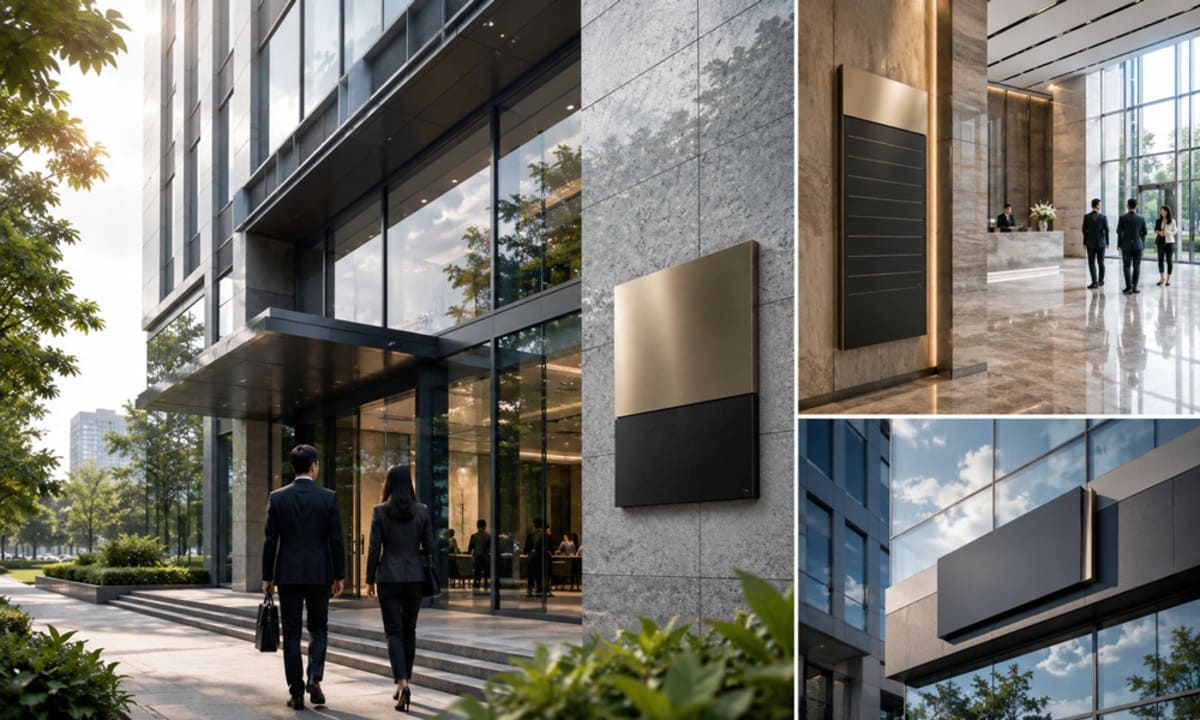
Businesses need to understand office building signage regulations when renting premises as a head office, branch, representative office or business location. Signage helps customers and partners identify the correct business location and is directly subject to legal requirements, building rules and lease provisions. Incorrect content, dimensions, language or placement may lead to a request for correction or removal, or to an administrative penalty. Businesses should therefore check the applicable requirements before installation to support stable and professional operations.
Table of Contents
- 1. What Is Office Building Signage?
- 2. Common Types of Signage in Office Buildings
- 3. Required Content on a Company Sign
- 4. Language Requirements for Office Signage
- 5. Size Requirements for Office Building Signage
- 6. Rules on Signage Placement in Office Buildings
- 7. Is Permission Required to Install Office Building Signage?
- 8. Penalties for Non-Compliant Signage
- 9. Common Mistakes When Installing Office Building Signage
- 10. Professional Office Leasing Support from Maison Office
- 11. (FAQ) – Frequently Asked Questions
1. What Is Office Building Signage?
Office building signage is a nameplate displaying a business’s identifying information at its leased office address. It usually includes the company name, address, telephone number and other necessary legal information. The sign helps customers, partners and authorities confirm that the business is operating at its registered head office, branch, representative office or business location.

In an office building, signage is not limited to a plate outside the company’s door. It may also appear on a floor directory, the directory in the reception lobby or another area approved by building management. Businesses must therefore comply with the law, the building’s internal rules and the terms agreed in the lease when installing signage.
2. Common Types of Signage in Office Buildings
Common office building signs identify tenants, help customers and partners find them, and contribute to a professional workplace. Depending on the location, purpose and building-management rules, businesses may use several types of signage.
2.1 Company Sign at the Office Entrance
A company sign at the office entrance is installed directly outside the leased premises and usually shows the company name, logo, room number or floor. This common form of identification helps customers, partners and authorities locate the business. The information must match the company’s legal records and the installation must follow the building’s standards.

2.2 Tenant Listing on the Lobby Directory
The lobby directory lists the companies leasing space in the building. It is usually located at reception, in the main lobby or near the lifts so visitors can find a company name, floor and room number. Directory information must be accurate, consistent with the lease and registered with building management.
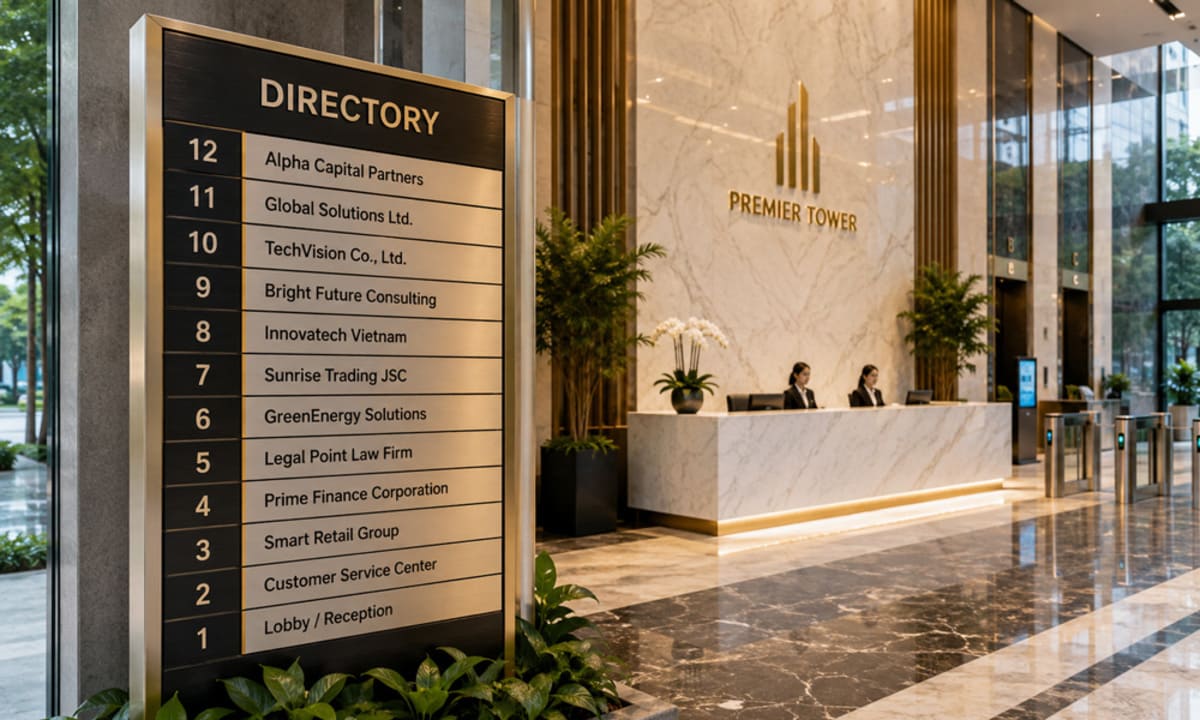
2.3 Floor Directional Signs
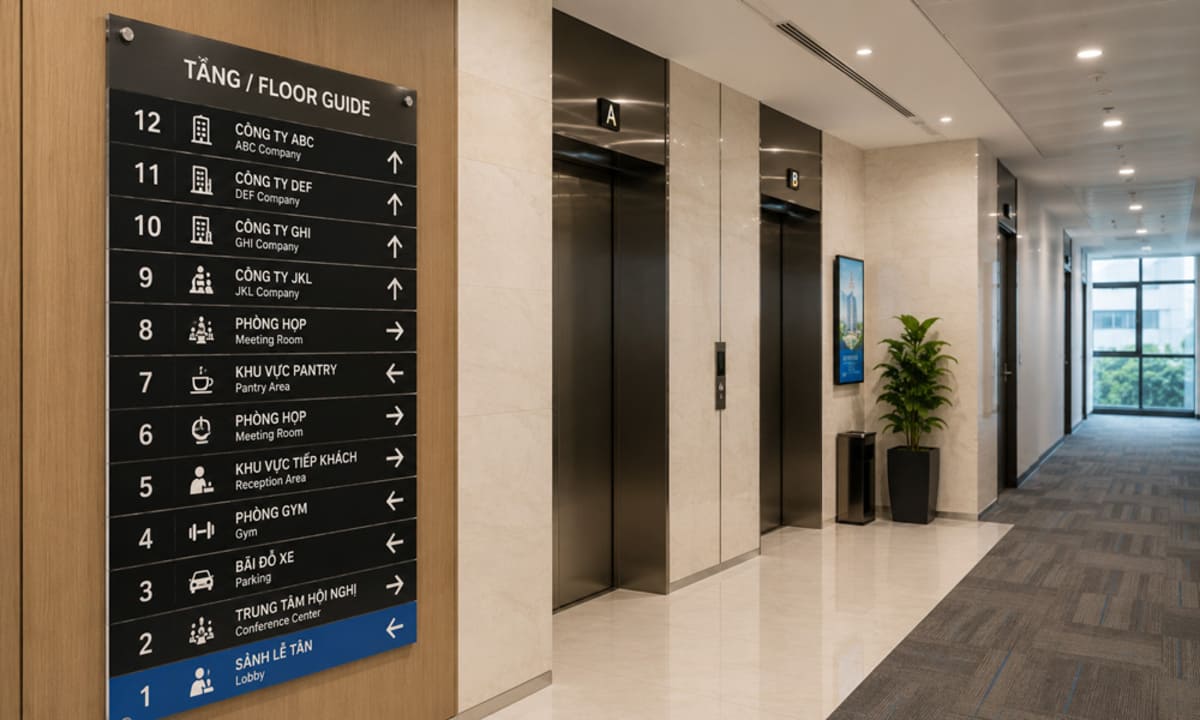
Floor directional signs are placed in lift lobbies, corridors or shared circulation areas to guide visitors to the correct office, department or workspace. They are particularly useful in multi-tenant buildings. The content should be concise, easy to read and correctly positioned without obstructing escape routes or fire prevention and fighting systems.
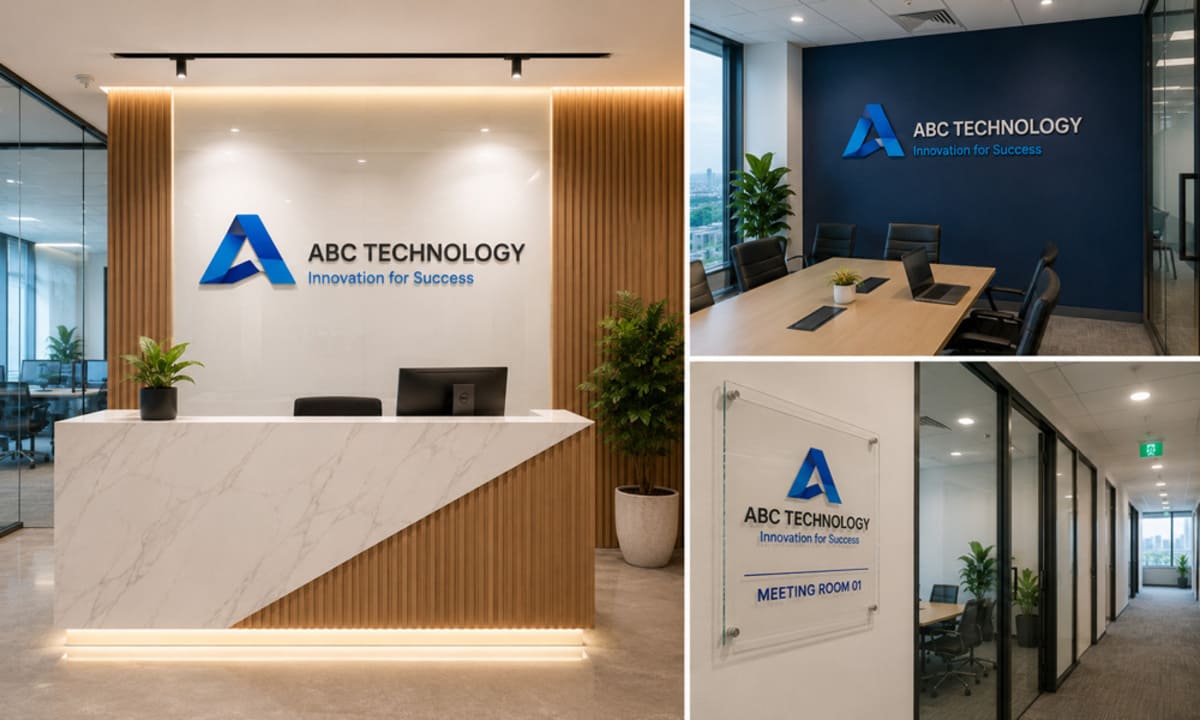
2.4 Logos and Identification Signs Within the Leased Premises
Logos and identification signs within the leased premises are often installed at an internal reception desk, on a backdrop wall, in meeting rooms or in visitor areas. They support brand recognition and a professional company image. However, if an item will be permanently fixed to a wall, glass panel, ceiling, floor or partition, the tenant should consult building management first to avoid breaching reinstatement requirements.
2.5 Facade or Exterior Building Signs
Facade or exterior building signs are commonly installed on the facade, podium or another external part of the property, making the brand visible from a major road. This option is generally available to large tenants, full-floor occupiers or tenants with a separate agreement with the developer. The relevant law, building rules and lease provisions should be checked carefully before installation.

3. Required Content on a Company Sign
Under the 2012 Law on Advertising, a sign used by an organisation or individual engaged in production or business activities must show the name of the directly supervising authority, if any; the name of the production or business establishment as stated in its business registration; its address; and its telephone number. For office tenants, this information should be clear, legible and consistent with the registered legal records.
A company sign should include the following:
- Business name: Use the exact name on the Business Registration Certificate, including the full legal form, such as Limited Liability Company or Joint Stock Company, and the branch or representative-office designation where applicable.
- Operating address: Show the registered head-office, branch, representative-office or business-location address. For premises in an office building, include the floor, room number, building name and street address where applicable.
- Contact telephone number: Use the company’s official telephone number so customers, partners and authorities can make contact when necessary.
- Directly supervising authority: Include this only where the enterprise, entity or organisation has a supervising authority under the applicable rules.
- Logo, website and tax code: These may be added to strengthen brand recognition, but they should not replace the required business name, address and telephone number.
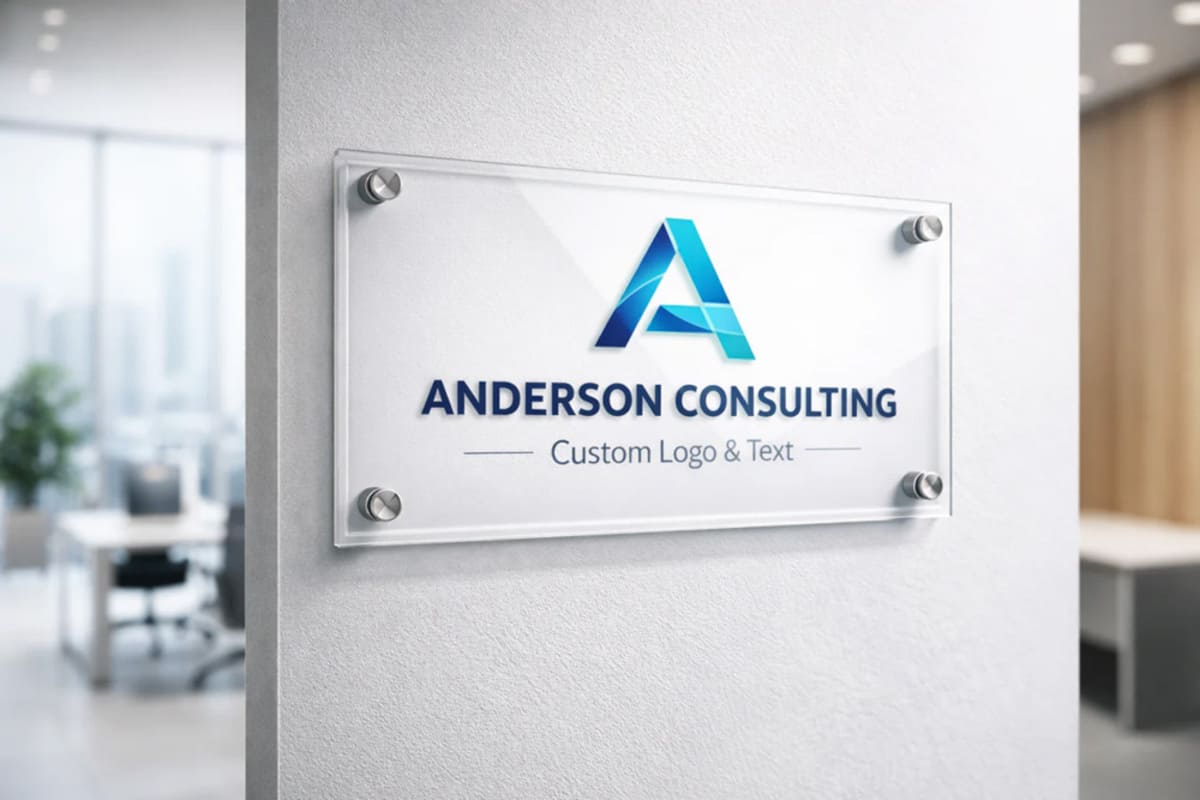
Businesses should avoid using only a trade name instead of the legal name, an abbreviation that does not match the registration records, an incomplete address or telephone number, or an address that differs from the licence. These errors may make a sign non-compliant and create difficulties when tax authorities, banks, partners or delivery providers verify the operating address. The details should be checked against the Business Registration Certificate before the design is approved.
In an office building, the sign must also comply with management specifications for dimensions, colours, materials and installation position. The tenant should send the design to building management or the developer for approval before production, while checking all information against its business registration documents to avoid correction costs.
4. Language Requirements for Office Signage
Office signage must meet the applicable language rules to remain legally compliant and avoid being returned for correction. A company sign must contain Vietnamese. If a foreign language is also used, it must not be more prominent than the Vietnamese text.
| Item | Applicable requirement |
|---|---|
| Mandatory language | The sign must contain Vietnamese. |
| Foreign name or abbreviation | May be used if registered by the business or used as part of its brand identity. |
| Size of foreign-language text | Must not be larger than the Vietnamese text; the foreign-language lettering may be no more than three-quarters of the size of the Vietnamese lettering. |
| Position of foreign-language text | Must be placed below the Vietnamese text. |
| Proper name, brand and logo | May appear on the sign but cannot replace the legal name in Vietnamese. |
These rules commonly affect office tenants with international trading names, foreign branches or representative offices, or businesses using an English-language brand. The design should show the full Vietnamese name stated on the Business Registration Certificate first, followed by the English name, abbreviation, logo, address and telephone number.
5. Size Requirements for Office Building Signage
Office building signage must comply with Article 34 of the 2012 Law on Advertising and the operating standards of the particular building. The law does not set one fixed size for every sign. Instead, it sets maximum limits for horizontal and vertical signs to protect safety and appearance and to prevent interference with public space.
| Type of sign | Size requirement or note |
|---|---|
| Horizontal sign | Maximum height of 2 m. Its length must not exceed the width of the building frontage. This format commonly applies to signs on the frontage, podium or exterior of the property. |
| Vertical sign | Maximum width of 1 m and maximum height of 4 m, without exceeding the height of the floor on which it is installed. |
| Office entrance nameplate | The law does not prescribe a fixed size; the dimensions normally follow the building’s own standards. |
| Lobby directory listing | The dimensions depend on the building’s shared identification system and are controlled by management to keep the tenant list consistent. |
| Logo or identification sign within the leased premises | Depends on the leased area and interior design. Management or developer consent is required if it will be fixed to a wall, glazing, ceiling or partition. |
For office tenants, the statutory size limits apply most clearly to facade signs, vertical signs and signs installed outside the building. Entrance nameplates, floor directional signs and lobby directory listings are usually smaller and follow the building’s own identification and operating standards.
A tenant should not install an oversized sign, lightbox, LED sign or metal frame outside the facade without approval. Under Article 48 of Decree 38/2021/ND-CP, using a sign that does not comply with the size requirements may result in a fine of VND 5,000,000 to VND 10,000,000.
6. Rules on Signage Placement in Office Buildings
The placement of signage in an office building must comply with both the law and the building’s operating rules.
Clause 4, Article 34 of the 2012 Law on Advertising provides that signs must not obstruct emergency exits or firefighting access, encroach on pavements or roadways, or affect public traffic.
Decree 103/2009/ND-CP also addresses the appearance, lettering, position and content of signs:
A sign may be written or placed only close to the gate or on the front of the head office or business premises of the organisation or individual. Each agency or organisation may place only one sign at its gate. At head offices or business premises independent from other organisations or individuals, no more than one horizontal sign and two vertical signs may be placed.
These provisions lead to several practical requirements for office signage:
- Do not obstruct escape routes or firefighting areas: Do not place signs at emergency exits, staircases, escape corridors, fire-equipment cabinets or areas used for rescue operations.
- Do not encroach on pavements or roadways: A sign on the frontage, podium or facade must not project into public space in a way that obstructs traffic.
- Preserve the building’s overall appearance: The design should suit the building exterior, shared identification system and operating standards.
- Do not install signage in common areas without approval: Reception lobbies, corridors, lifts, facades and rooftops require prior approval from building management or the developer.

For office tenants, the usual permitted locations are the office entrance, the lobby directory, a floor directional sign or an internal reception area within the leased premises. Facade or exterior building signs are generally limited to large tenants, full-floor or multi-floor occupiers, or tenants with specific signage rights in the lease.
7. Is Permission Required to Install Office Building Signage?
Installing office building signage does not always require a separate permit. Businesses should distinguish between internal nameplates and signs installed outside the building. Small signs at an office entrance, lobby directory listings and floor directional signs generally need registration and approval from building management. Large exterior signs, facade signs or structures fixed to the building require further legal checks before installation.
7.1 Cases That Normally Require Only Building Registration
Registration with building management or the developer is generally sufficient for signage within the building’s internal operating area. These signs are used for identification and directions and have limited impact on the structure or external public space.
Common examples include:
- Office entrance nameplate: Installed outside the leased premises and usually showing the company name, logo, room number or floor.
- Lobby directory listing: Shows the company name, floor and room number on the building’s shared directory system.
- Floor directional sign: Placed in a corridor, lift lobby or common circulation area in accordance with the building’s standards.
- Logo within the leased premises: Installed at an internal reception desk, on a backdrop wall, in a meeting room or in a visitor area belonging to the leased space.

The tenant should submit the design to management in advance so the company name, dimensions, materials, colours, installation position and construction method can be checked. Registration helps the sign remain consistent with the building’s shared identity and reduces the risk of removal or alteration after installation.
7.2 Cases Requiring Additional Legal Checks
Additional legal checks are needed when a sign is large, installed outside the building or may affect the property’s appearance, structure, traffic or fire safety. These signs carry greater legal risk than internal nameplates.
Cases requiring attention include:
- Frontage, facade or exterior signs: Installed outside the building, on the podium or in another position visible from a major road.
- Lightboxes, LED signs and signs with metal structures: May affect the structure, electrical system, installation safety or appearance of the property.
- Large signs: Must be checked against the size limits in the 2012 Law on Advertising.
- Signs near emergency exits, fire-equipment cabinets or escape corridors: Must not obstruct emergency or firefighting access.
- Signs extending into public areas: Must not encroach on pavements or roadways or affect public traffic.
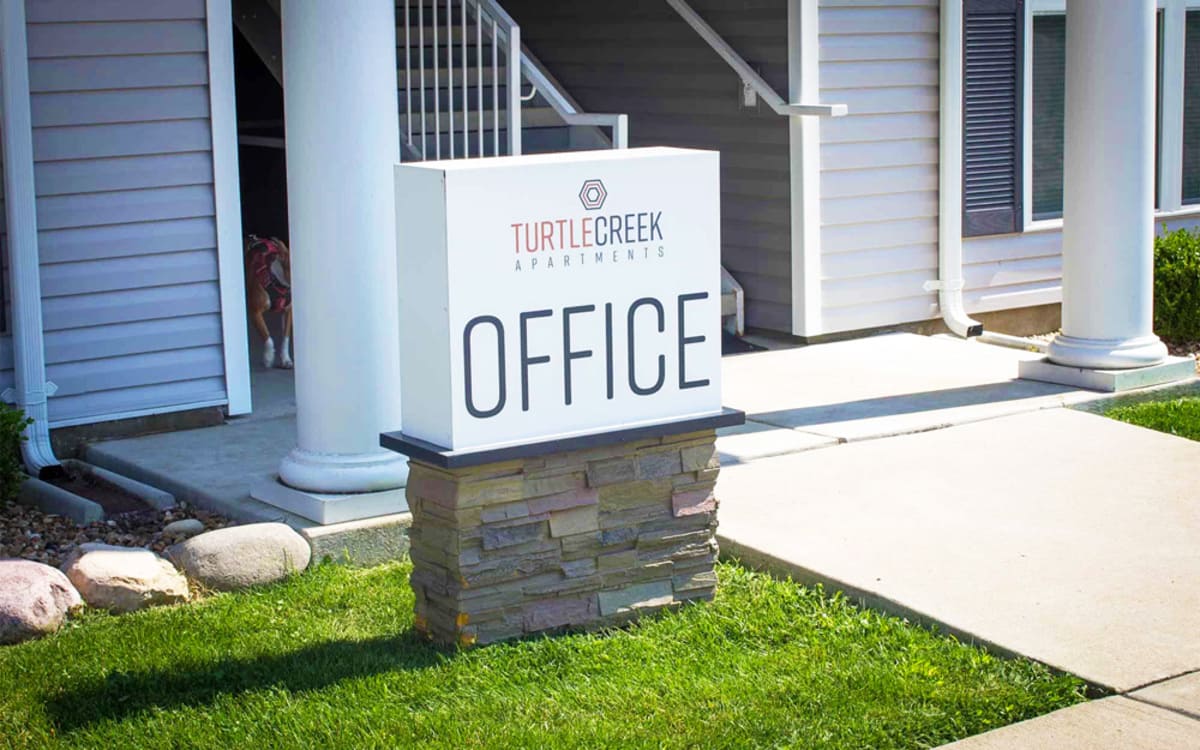
Under Decree 38/2021/ND-CP, a sign that obstructs an emergency exit or firefighting access, encroaches on a pavement or roadway, affects public traffic or harms the area’s appearance may lead to a fine of VND 15,000,000 to VND 20,000,000 and compulsory removal of the non-compliant sign.
7.3 Cases That Should Be Agreed in the Lease
In addition to legal requirements, signage rights in an office building depend heavily on the lease and the developer’s rules. If a tenant requires brand visibility beyond the standard company nameplate, the relevant rights should be agreed during office lease negotiations.
The following matters should be addressed in the lease or an appendix:
- Logo placement in the main lobby or shared reception area: State the approved position and any operational conditions.
- Signs on the frontage, facade, podium or rooftop: Confirm whether exterior brand visibility is permitted.
- Signs in lifts, common corridors or other high-traffic areas: Specify the permitted common-area positions.
- Special identification rights for major occupiers: Record any rights linked to leasing a full floor, several floors or a large area.
- Designs outside the building standard: Agree any different materials, lighting, dimensions or design treatment.
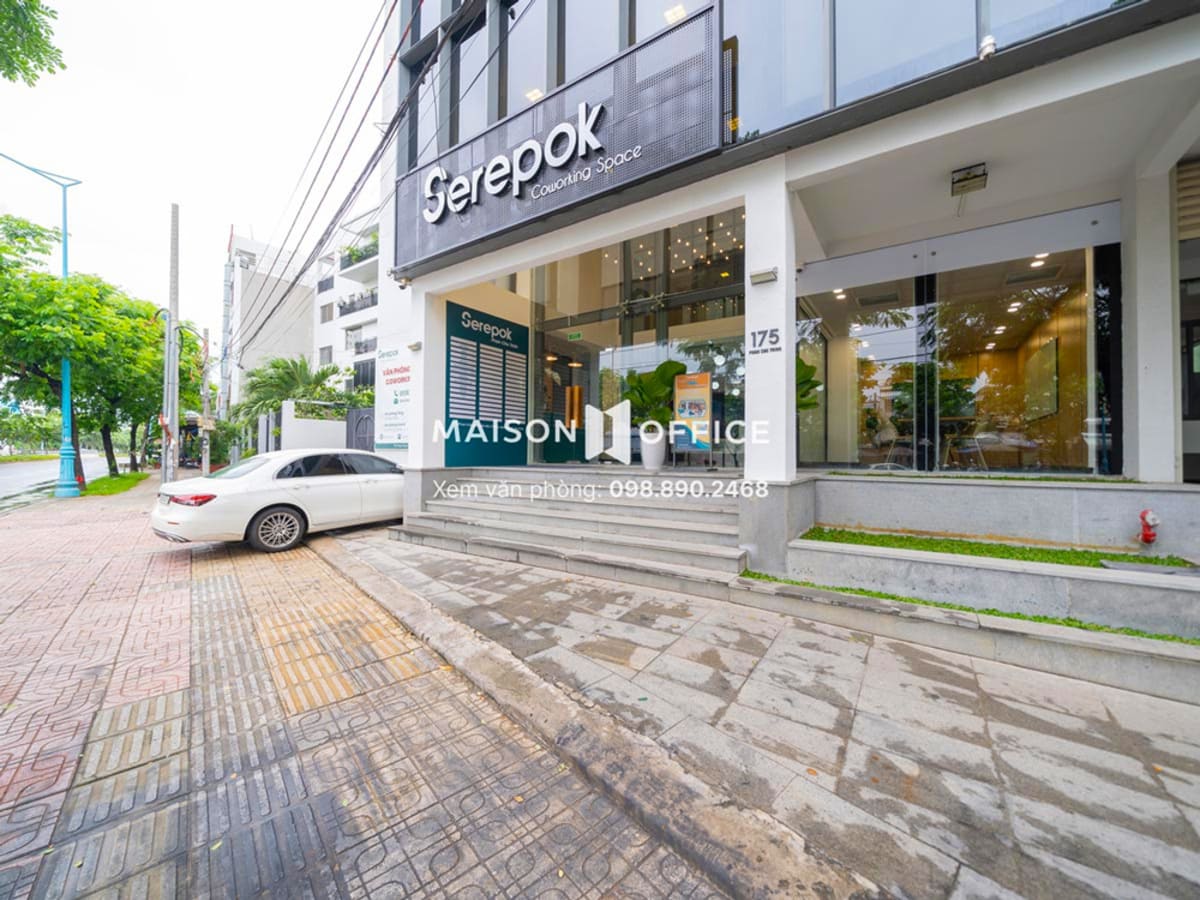
The agreement should clarify the permitted position, maximum size, fabrication cost, any maintenance fee, maintenance responsibility, removal conditions and the obligation to reinstate the premises at the end of the office lease agreement. Clear provisions help protect the tenant’s brand identity and reduce disputes with building management during occupancy.
8. Penalties for Non-Compliant Signage
A business that installs non-compliant signage in an office building may face an administrative fine depending on the violation. Common breaches include omitting mandatory information, using incorrect dimensions or language, blocking an escape route, encroaching on a pavement or harming the building’s appearance.
Article 34 of the 2012 Law on Advertising requires the sign of a business organisation or individual to show the name of the production or business establishment as stated in its Business Registration Certificate, together with its address and telephone number. The sign must also comply with the rules on lettering, dimensions and installation position.
| Violation | Reference fine under Decree 38/2021/ND-CP | Remedial measure |
|---|---|---|
| Failure to show all mandatory information, such as the supervising authority where applicable, the registered business name, address and telephone number | VND 5,000,000-10,000,000 | Compulsory removal of the non-compliant sign |
| Use of a sign with dimensions that do not comply with the rules | VND 5,000,000-10,000,000 | Compulsory removal of the non-compliant sign |
| Incorrect or incomplete use of the Vietnamese name on the sign | VND 10,000,000-15,000,000 | Compulsory removal of the non-compliant sign |
| Installation of a sign that obstructs an emergency exit or firefighting access | VND 15,000,000-20,000,000 | Compulsory removal of the non-compliant sign |
| Installation of a sign that encroaches on a pavement or roadway or affects public traffic | VND 15,000,000-20,000,000 | Compulsory removal of the non-compliant sign |
| Writing, erecting, placing or fixing a sign in a way that harms the area’s appearance | VND 15,000,000-20,000,000 | Compulsory removal of the non-compliant sign |
These penalty ranges and the compulsory-removal measure are stated in Article 48 of Decree 38/2021/ND-CP. In office buildings, risk often arises when a tenant installs a sign on the exterior without approval, uses an oversized sign, displays an incorrect legal name, or places a sign in a common area, escape route or fire-safety area without management approval.
Before installation, businesses should check the sign’s content, language, dimensions and position. For leased offices, building management or the developer should confirm the design, which should also be checked against the Business Registration Certificate, building rules and lease provisions.
9. Common Mistakes When Installing Office Building Signage
Signage errors often occur because businesses do not clearly distinguish between legal requirements, building rules and the terms agreed in the lease. Common mistakes include:
- Incorrect legal name: Using a trade name, abbreviation or brand instead of the full name on the Business Registration Certificate.
- Missing mandatory information: Omitting the company name, address, telephone number or other information required by law.
- Incorrect use of a foreign language: Displaying only the English name, placing foreign-language text above the Vietnamese text, or making it larger than the Vietnamese text.
- Incorrect sign dimensions: Designing a horizontal, vertical or facade sign that exceeds the legal limits or does not follow the building standard.
- Incorrect placement: Installing a sign at an emergency exit, escape corridor, fire-safety area, frontage or facade without approval.
- Unauthorised use of common areas: Fixing a sign in the lobby, lift, corridor, directory or facade without registering it with building management.
- Producing the sign before design approval: Proceeding before management has confirmed the dimensions, materials, colours, lighting and installation method.
- Ignoring the lease: Failing to check the permitted position, construction cost, maintenance fee, removal responsibility and reinstatement obligation.
- Not updating changed information: Delaying a replacement after a change to the company name, address, telephone number, branch or representative office.
- Inconsistent building appearance: Using an overly prominent sign, unsuitable materials, excessive lighting or a design that conflicts with the building’s visual standards.

In summary, office building signage must comply with requirements for content, language, dimensions and installation position, as well as the operating rules of the particular building. Businesses should verify their legal information and agree the design with building management or the developer before installation to reduce the risk of fines, removal or disputes during the lease term.
10. Professional Office Leasing Support from Maison Office
Choosing an office involves more than location, area and rent. After signing the lease, the tenant must also deal with the registration of its business address, company signage, use of common areas, building rules and additional costs. These matters should be checked carefully to reduce legal risk, disputes with building management and unexpected costs during occupancy.
Drawing on its experience advising thousands of domestic and international businesses, Maison Office helps tenants find premises suited to their actual requirements, budget, headcount and the legal conditions for registering a head office, branch or representative office. Its consultants assist with building inspections, option comparisons, operating-condition checks, clarification of signage rules and building regulations, and review of important lease provisions.
 |
 |
Businesses seeking office space in Ho Chi Minh City, Hanoi or Da Nang can contact Maison Office for suitable building options, prompt quotations and guidance through the office leasing process. Maison Office supports tenants in finding suitable workspace, controlling costs and preparing for efficient operations after handover.
11. (FAQ) – Frequently Asked Questions
11.1 What Information Must a Company Sign in an Office Building Show?
The sign should show the business name stated on the Business Registration Certificate, the office address and a contact telephone number. The company may add its logo, website, tax code or international trading name, but these should not replace the mandatory legal information.
11.2 Can a Company Display Its Logo on the Building Facade?
Yes, potentially, but the company must not install it without approval from the developer or building management. A logo or sign on the frontage, facade, podium or rooftop also requires checks on dimensions, position, appearance, fire safety and the relevant lease provisions.
11.3 Does a Serviced Office Need Company Signage?
It may be required if the serviced-office address is used to register a head office, branch, representative office or business location. The form of signage depends on the operator’s policy and may be a reception listing, directory entry, room plate or internal identification system.
11.4 Must an Office Tenant Display a Company Sign?
Yes, if the leased office address is used as a registered head office, branch, representative office or business location. The sign confirms the business’s legal presence at the operating address and helps customers, partners and authorities verify its information.
11.5 Who Is Responsible for Producing the Sign?
The tenant is normally responsible for preparing the content and design and paying the production cost. Building management or the developer controls the installation position, dimensions, materials, colours and construction method so the sign complies with operating rules, the building’s overall appearance and safety requirements.


